%20!important%3B%22%2F%3E%0A%3Cpath%20d%3D%22M58.9724%2026.1292C57.6595%2026.1292%2055.9552%2025.7092%2054.1179%2024.896L54.1958%2021.3279H54.591C55.6132%2024.423%2057.4239%2025.3179%2058.9971%2025.3179C60.4411%2025.3179%2061.412%2024.5579%2061.412%2023.2184C61.412%2021.6186%2059.8369%2021.1455%2057.8172%2020.3323C55.4555%2019.3614%2054.04%2018.4437%2054.04%2016.5323C54.04%2014.1972%2055.902%2012.6753%2058.79%2012.6753C60.2717%2012.7131%2061.7288%2013.062%2063.0669%2013.6994L62.9871%2017.0567H62.5672C61.754%2014.1972%2060.1808%2013.4885%2058.7672%2013.4885C57.2187%2013.4885%2056.2231%2014.3017%2056.2231%2015.4569C56.2231%2016.899%2057.8761%2017.2657%2060.2131%2018.2366C62.0238%2018.9453%2063.5989%2019.8116%2063.5989%2022.0935C63.5913%2024.6547%2061.6324%2026.1292%2058.9724%2026.1292Z%22%20fill%3D%22%23123236%22%20style%3D%22fill%3A%20rgb(18%2C%2050%2C%2054)%20!important%3B%22%2F%3E%0A%3Cpath%20d%3D%22M63.8701%2025.5209C65.0234%2025.4164%2065.9601%2025.0744%2065.9601%2023.2637V15.4471C65.9601%2013.6364%2065.0101%2013.2944%2063.8891%2013.1899V12.8289H68.6106V23.2695C68.6106%2025.0801%2069.5606%2025.4221%2070.7101%2025.5266V25.8933H63.8701V25.5209ZM65.1298%209.1809C65.1368%208.71493%2065.3284%208.27077%2065.6625%207.9459C65.9967%207.62104%2066.446%207.44208%2066.912%207.44817C67.3783%207.44157%2067.8282%207.62033%2068.1627%207.94525C68.4973%208.27017%2068.6891%208.7146%2068.6961%209.1809C68.6954%209.41374%2068.6485%209.64416%2068.5583%209.8588C68.468%2010.0734%2068.3362%2010.2681%2068.1703%2010.4315C68.0044%2010.5949%2067.8078%2010.7238%2067.5919%2010.8108C67.3759%2010.8979%2067.1448%2010.9412%2066.912%2010.9384C66.4428%2010.9389%2065.9923%2010.7543%2065.6586%2010.4244C65.3248%2010.0946%2065.1348%209.64629%2065.1298%209.1771V9.1809Z%22%20fill%3D%22%23123236%22%20style%3D%22fill%3A%20rgb(18%2C%2050%2C%2054)%20!important%3B%22%2F%3E%0A%3Cpath%20d%3D%22M85.9783%2025.521C86.9492%2025.4165%2087.7358%2025.0746%2087.7358%2023.2639V17.1516C87.7358%2015.3162%2086.6604%2014.503%2085.3741%2014.503C84.4241%2014.503%2083.5387%2014.9476%2082.6989%2015.8919C82.7255%2016.1807%2082.7521%2016.4961%2082.7521%2016.8115V23.2715C82.7521%2025.0822%2083.5387%2025.4241%2084.5096%2025.5286V25.8954H78.3707V25.5286C79.3416%2025.4241%2080.1282%2025.0822%2080.1282%2023.2715V17.1592C80.1282%2015.3238%2079.0775%2014.5106%2077.7665%2014.5106C76.8165%2014.5106%2075.9824%2014.9552%2075.1426%2015.8995V23.2715C75.1426%2025.0822%2075.9311%2025.4241%2076.9799%2025.5286V25.8954H70.499V25.5286C71.601%2025.4241%2072.494%2025.0822%2072.494%2023.2715V15.4549C72.494%2013.6442%2071.601%2013.3022%2070.499%2013.1977V12.8291H75.1426V15.1908C76.1933%2013.5378%2077.5043%2012.6714%2079.1041%2012.6714C80.7039%2012.6714%2082.0947%2013.5112%2082.5678%2015.3219C83.6698%2013.5891%2085.0378%2012.6714%2086.687%2012.6714C88.6535%2012.6714%2090.3863%2014.0014%2090.3863%2016.8172V23.2772C90.3863%2025.0879%2091.2508%2025.4299%2092.3015%2025.5344V25.901H85.9783V25.521Z%22%20fill%3D%22%23123236%22%20style%3D%22fill%3A%20rgb(18%2C%2050%2C%2054)%20!important%3B%22%2F%3E%0A%3Cpath%20d%3D%22M98.5056%2026.0987C95.1217%2026.0987%2092.209%2023.5014%2092.209%2019.329C92.209%2015.1566%2095.1217%2012.6658%2098.5056%2012.6658C101.889%2012.6658%20104.829%2015.1851%20104.829%2019.329C104.829%2023.4729%20101.889%2026.0987%2098.5056%2026.0987ZM95.1996%2019.329C95.1996%2022.2949%2096.1705%2025.3368%2098.5056%2025.3368C100.841%2025.3368%20101.838%2022.3196%20101.838%2019.329C101.838%2016.3384%20100.814%2013.4276%2098.5056%2013.4276C96.1971%2013.4276%2095.1996%2016.365%2095.1996%2019.329Z%22%20fill%3D%22%23123236%22%20style%3D%22fill%3A%20rgb(18%2C%2050%2C%2054)%20!important%3B%22%2F%3E%0A%3Cpath%20d%3D%22M106.111%2015.2991C105.402%2013.6195%20104.669%2013.3041%20103.855%2013.1996V12.8291H110.315V13.1958C109.162%2013.3269%20108.453%2013.6955%20109.109%2015.2953L112.073%2022.483L114.959%2015.2953C115.616%2013.6423%20114.723%2013.3003%20113.648%2013.1958V12.8291H118.187V13.1958C117.321%2013.3003%20116.508%2013.6423%20115.825%2015.3219L111.602%2025.8878H110.578L106.111%2015.2991Z%22%20fill%3D%22%23123236%22%20style%3D%22fill%3A%20rgb(18%2C%2050%2C%2054)%20!important%3B%22%2F%3E%0A%3Cpath%20d%3D%22M122.474%2025.4944C123.68%2025.3899%20124.678%2025.0232%20124.678%2023.1327V9.7529C124.678%207.8643%20123.68%207.49761%20122.474%207.39311V6.99976H131.261C134.936%206.99976%20137.506%209.49065%20137.506%2012.7434C137.506%2016.3914%20134.466%2018.5689%20130.737%2018.5689H127.588V23.1289C127.588%2025.0289%20128.613%2025.3861%20129.792%2025.4906V25.8839H122.474V25.4944ZM127.588%2017.7291H130.248C132.846%2017.7291%20134.446%2015.4737%20134.446%2012.7434C134.446%2010.0948%20132.977%207.83768%20130.406%207.83768H127.598L127.588%2017.7291Z%22%20fill%3D%22%23123236%22%20style%3D%22fill%3A%20rgb(18%2C%2050%2C%2054)%20!important%3B%22%2F%3E%0A%3Cpath%20d%3D%22M137.533%2025.5207C138.635%2025.4162%20139.553%2025.0743%20139.553%2023.2636V15.4469C139.553%2013.6362%20138.635%2013.2943%20137.533%2013.1898V12.8288H142.23V17.0258C142.832%2014.5084%20144.852%2012.2512%20147.449%2012.7756L147.056%2015.4793H146.866C144.713%2014.5863%20142.589%2016.1613%20142.222%2019.2032V23.2693C142.222%2025.08%20143.14%2025.422%20144.242%2025.5265V25.8931H137.525L137.533%2025.5207Z%22%20fill%3D%22%23123236%22%20style%3D%22fill%3A%20rgb(18%2C%2050%2C%2054)%20!important%3B%22%2F%3E%0A%3Cpath%20d%3D%22M153.488%2026.0987C150.366%2026.0987%20147.533%2023.6591%20147.533%2019.3557C147.533%2015.2631%20149.946%2012.6658%20153.332%2012.6658C156.794%2012.6658%20158.709%2015.3941%20158.682%2018.9623H150.322C150.4%2022.5571%20152.184%2024.4458%20154.493%2024.4458C155.937%2024.4458%20157.326%2023.7636%20158.403%2022.3728L158.717%2022.4508C158.326%2023.5228%20157.614%2024.4484%20156.679%2025.1012C155.743%2025.754%20154.629%2026.1023%20153.488%2026.0987ZM150.34%2018.2023H155.954C155.876%2015.7608%20154.958%2013.4523%20153.252%2013.4523C151.417%2013.4523%20150.473%2015.9451%20150.34%2018.2023Z%22%20fill%3D%22%23123236%22%20style%3D%22fill%3A%20rgb(18%2C%2050%2C%2054)%20!important%3B%22%2F%3E%0A%3Cpath%20d%3D%22M164.817%2026.1292C163.506%2026.1292%20161.8%2025.7092%20159.964%2024.896L160.042%2021.3279H160.432C161.456%2024.423%20163.265%2025.3179%20164.84%2025.3179C166.282%2025.3179%20167.253%2024.5579%20167.253%2023.2184C167.253%2021.6186%20165.68%2021.1455%20163.658%2020.3323C161.298%2019.3614%20159.881%2018.4437%20159.881%2016.5323C159.881%2014.1972%20161.743%2012.6753%20164.631%2012.6753C166.113%2012.7128%20167.57%2013.0618%20168.908%2013.6994L168.83%2017.0567H168.412C167.599%2014.1972%20166.024%2013.4885%20164.612%2013.4885C163.063%2013.4885%20162.066%2014.3017%20162.066%2015.4569C162.066%2016.899%20163.719%2017.2657%20166.056%2018.2366C167.867%2018.9453%20169.44%2019.8116%20169.44%2022.0935C169.434%2024.6547%20167.462%2026.1292%20164.817%2026.1292Z%22%20fill%3D%22%23123236%22%20style%3D%22fill%3A%20rgb(18%2C%2050%2C%2054)%20!important%3B%22%2F%3E%0A%3Cpath%20d%3D%22M175.374%2026.1292C174.061%2026.1292%20172.357%2025.7092%20170.519%2024.896L170.597%2021.3279H170.992C172.015%2024.423%20173.825%2025.3179%20175.398%2025.3179C176.842%2025.3179%20177.813%2024.5579%20177.813%2023.2184C177.813%2021.6186%20176.238%2021.1455%20174.219%2020.3323C171.857%2019.3614%20170.441%2018.4437%20170.441%2016.5323C170.441%2014.1972%20172.303%2012.6753%20175.191%2012.6753C176.673%2012.7131%20178.13%2013.062%20179.468%2013.6994L179.388%2017.0567H178.969C178.155%2014.1972%20176.582%2013.4885%20175.169%2013.4885C173.62%2013.4885%20172.625%2014.3017%20172.625%2015.4569C172.625%2016.899%20174.278%2017.2657%20176.615%2018.2366C178.425%2018.9453%20180%2019.8116%20180%2022.0935C179.991%2024.6547%20178.022%2026.1292%20175.374%2026.1292Z%22%20fill%3D%22%23123236%22%20style%3D%22fill%3A%20rgb(18%2C%2050%2C%2054)%20!important%3B%22%2F%3E%0A%3Cpath%20d%3D%22M22.4922%2011.2518C22.4892%208.37895%2021.3888%205.61569%2019.4159%203.52733C17.4431%201.43898%2014.7468%200.183268%2011.8788%200.0170703V0H10.6134V0.0170703C7.74531%200.183268%205.04911%201.43898%203.07625%203.52733C1.10338%205.61569%200.00294138%208.37895%200%2011.2518V33.1189H0.632691C2.96479%2033.1153%205.2383%2032.388%207.13939%2031.0372C9.04048%2029.6864%2010.4754%2027.7789%2011.2461%2025.5778C12.018%2027.7776%2013.4533%2029.6838%2015.3543%2031.0335C17.2553%2032.3832%2019.5281%2033.1097%2021.8595%2033.1131H22.4922V11.2518ZM21.2268%2011.2518C21.2224%2013.7878%2020.2544%2016.2273%2018.5187%2018.0762C16.783%2019.9252%2014.4094%2021.0453%2011.8788%2021.2096V1.27869C14.4122%201.44322%2016.7882%202.56537%2018.5246%204.41749C20.261%206.26962%2021.2277%208.71304%2021.2287%2011.2518H21.2268ZM1.26731%2031.8287V11.2518C1.26878%208.71426%202.23567%206.27223%203.97174%204.42148C5.70781%202.57073%208.083%201.44987%2010.6153%201.2863V21.8746C10.6096%2024.4098%209.64093%2026.8482%207.90542%2028.6963C6.16991%2030.5443%203.79715%2031.664%201.26731%2031.8287ZM21.2287%2031.8287C18.8025%2031.6704%2016.5171%2030.6333%2014.8004%2028.9116C13.0836%2027.1899%2012.0531%2024.9017%2011.9016%2022.4751C13.8477%2022.3595%2015.7303%2021.7405%2017.3653%2020.6787C19.0003%2019.6169%2020.3315%2018.1487%2021.2287%2016.4179V31.8287Z%22%20fill%3D%22%23123236%22%20style%3D%22fill%3A%20rgb(18%2C%2050%2C%2054)%20!important%3B%22%2F%3E%0A%3C%2Fsvg%3E)

It was a revolutionary idea in the 1830s, and it remains one today — virtually anyone can learn to make their own scientific equipment. With a few dollars’ worth of glass tubing, a flame, and a little practice, you can create all kinds of chemical analysis kits. Because the glass itself is airtight, you can control which chemicals go in, and because it’s clear, you can observe what happens to those chemicals as you manipulate them. If they don’t do what you intend, you can reignite the flame, modify your glass apparatus, and try again.
This insight helped build the modern laboratory: Work wherever you want to, but work in glass, and you’ll reveal life’s most intricate mysteries.
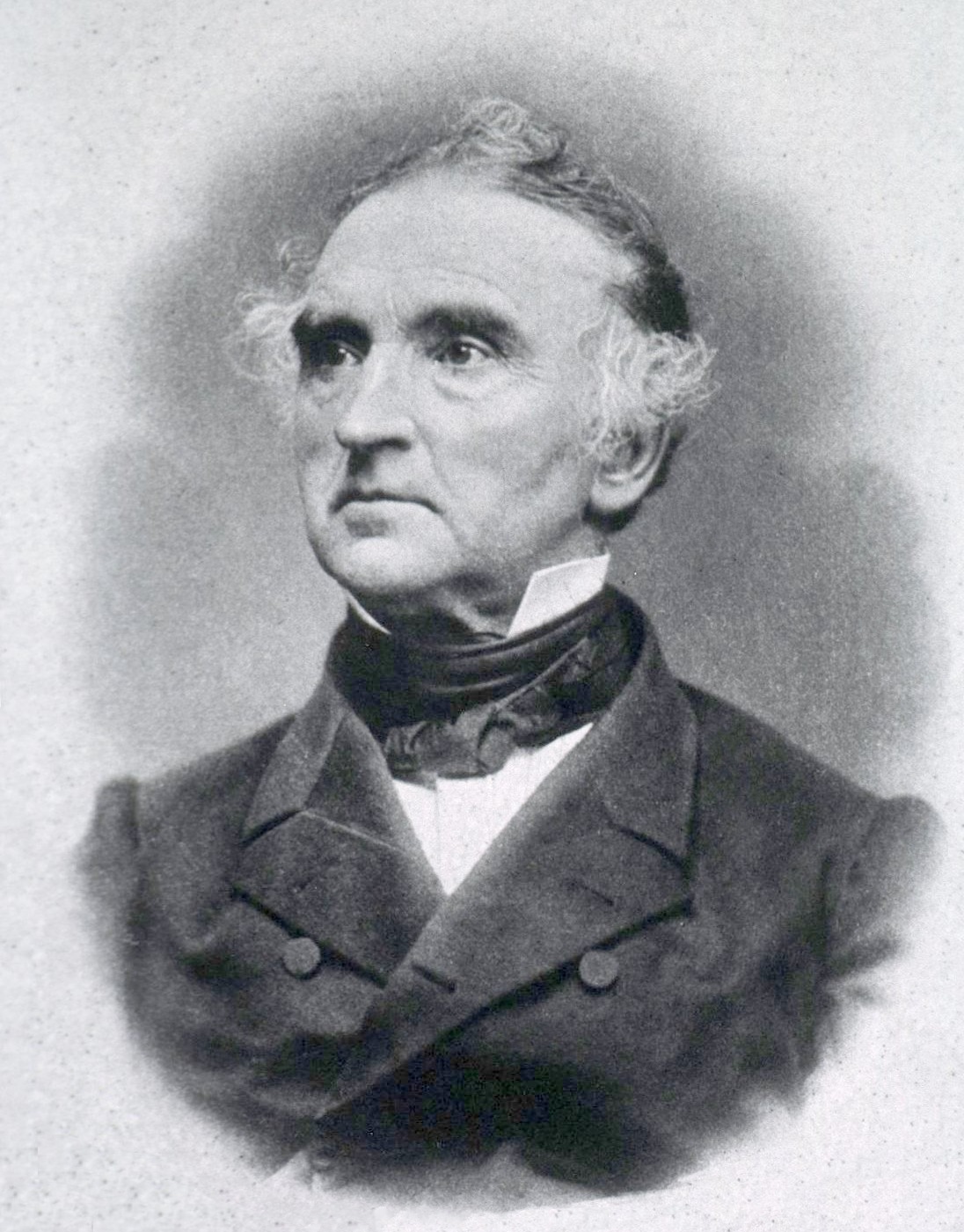
The person who catalyzed this idea, Justus Liebig, had the superlative career title of “Extraordinary Professor of Chemistry” (although his job’s “extraordinary” nature may have had more to do with its nominal compensation than anything else). In fact, Liebig wasn’t excited about the position he held, writing to his parents that he had “no great desire” for it. He would have preferred to stay in Paris — the center of the chemistry universe at the time, and a city where, even at twenty-one years old, Liebig had already begun to make a name for himself. But the University of Giessen had offered him a modest stipend to establish a lab, so, in 1821, Liebig accepted the constraints of small-town life and packed himself off there.
The move (and modest budget) forced Liebig to perform chemical analysis in new ways. While in Paris, studying under the esteemed French chemist Joseph-Louis Gay-Lussac, Liebig had analyzed silver fulminate, letting it combust and then collecting the carbon dioxide that resulted. Because carbon dioxide is hard to weigh,1 Liebig had been taught to measure its volume using an eudiometer, a type of inverted, graduated cylinder where gases could be trapped and their volume read from markings on the glass. This device was costly to make and finicky to use, and Gay-Lussac relied on specialized glassblowers to help design, produce, and maintain it. With such infrastructure missing in Giessen, Liebig’s research stalled.
If necessity is the mother of all invention, then ambition is its accelerant. Dissatisfied with teaching pure theory at the University, Liebig founded an independent institute to impart the tactile skills of applied chemistry. And dissatisfied with the equipment available in Giessen, Liebig traveled back to Paris to learn glassblowing — a skill he then passed on to his students.

Even as he gained these practical skills, he picked intellectual fights with prominent chemists in Paris and Berlin, insisting that their methods of analyzing organic molecules (which measured carbon and nitrogen together from a single volume of mixed combustion gases) were flawed. By 1830, Liebig knew how to make his own glassware and was now prepared to back up his published claims of superior analytical excellence.
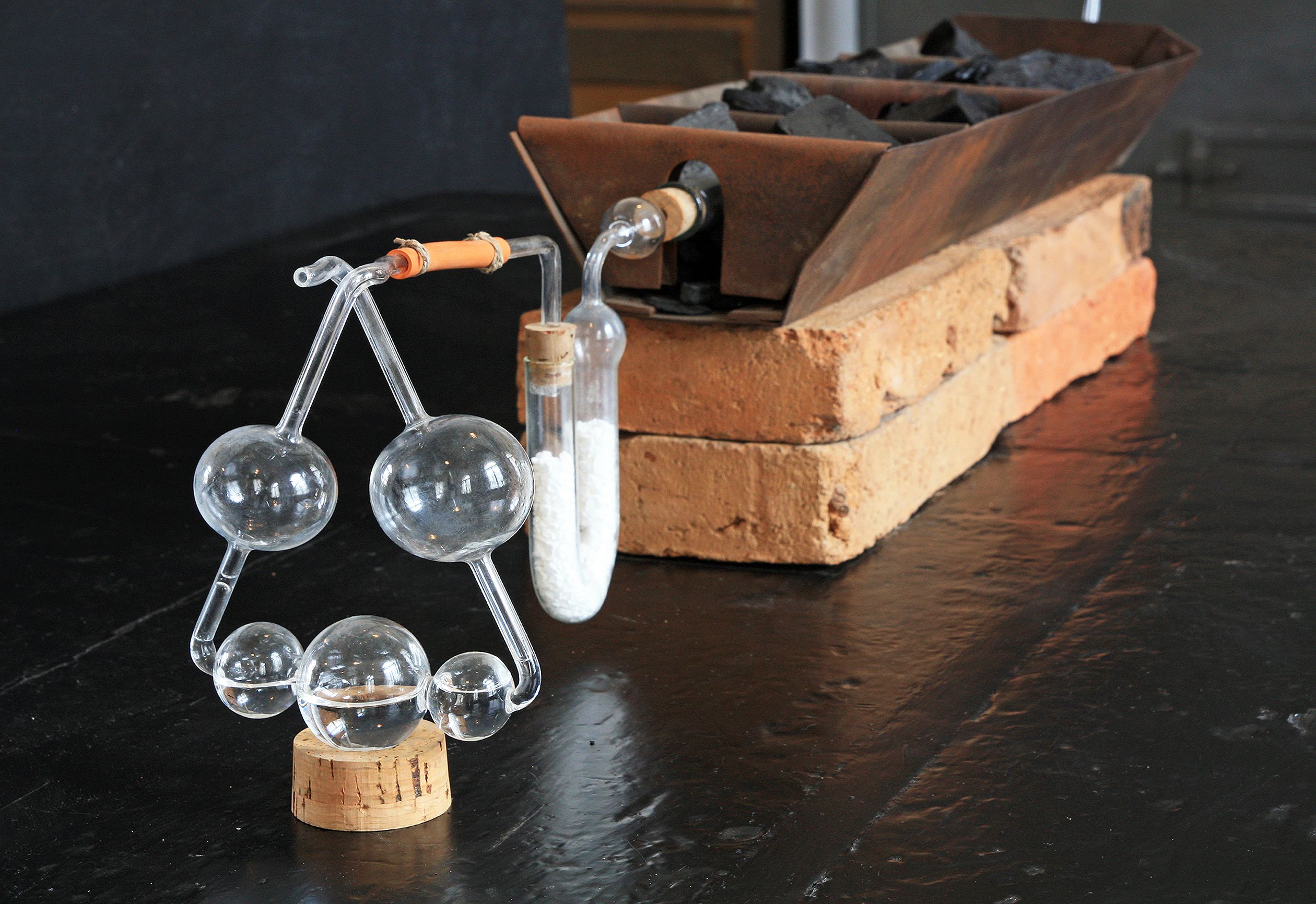
The result was the Kaliapparat, a twisted glass triangle that Liebig used to analyze the composition of morphine.2 The principle behind it was simple: Fill the bottom of the Kaliapparat with potassium hydroxide, then force morphine’s combustion gases through it. As the gases bubbled through the Kaliapparat’s bulbs, any CO₂ present would react with the potassium hydroxide, trapping the carbon but allowing the rest (hydrogen, nitrogen, and oxygen) to pass through. Then, by weighing the Kaliapparat and subtracting its pre-reaction mass, Liebig could determine exactly how much carbon, by mass, had been in the original morphine sample.
As an analytical tool, the Kaliapparat was middling. Liebig’s original goal had been to determine morphine’s nitrogen content, which proved challenging given that the nitrogen passing through the apparatus commingled and reacted with other gases. In fact, historian Catherine Jackson states in her book Molecular World that it was even self-admittedly a failure. “In private, Liebig was even more scathing. As he admitted to Berzelius [a dominant figure in European chemistry and a correspondent], his method of nitrogen determination was ‘tiresome, time-consuming and, in a word, quite unbearable,’ while nitrogen’s side reactions had driven him to ‘despair,’” she writes. However, the Kaliapparat was indeed reliable for measuring carbon — and at a much lower cost than the volumetric-based Parisian equipment of the day. So when he published his results in 1831, Liebig simply de-emphasized the nitrogen analysis performed with it and focused on the glassware itself, christening it “A New Apparatus.”
It would take a few more years, however, for the glass vessel to gain widespread adoption. In 1833, Liebig slipped instructions on how to make a Kaliapparat into an article he had translated from French to German. In 1834, one of his assistants also demonstrated how to make a Kaliapparat at a chemistry meeting. And, in 1839, Liebig published a textbook on organic analysis that included instructions on the making and use of Kaliapparat. According to Jackson, Liebig’s effort to publicize the device — and encourage other chemists to make their own — was “explicitly pedagogical.” Liebig sought “to overturn Parisian chemical orthodoxy … [wanting] chemists everywhere to see and understand, to make and use the Kaliapparat and to prove its worth by widespread replication.”
Finally, Liebig’s efforts paid off, and the 1840s became a golden era of amateur glassblowing. Chemists everywhere took up the torch, replicating Liebig’s Kaliapparat (a stylized version of which would be used in the American Chemical Society logo in the 20th century) and producing designs of their own. Glass vessels evolved, and organic analysis flourished as scientists could finally determine repeatable values for a sample’s carbon content. But most importantly, glassblowing established itself as a need-to-know process for anyone doing serious chemistry.
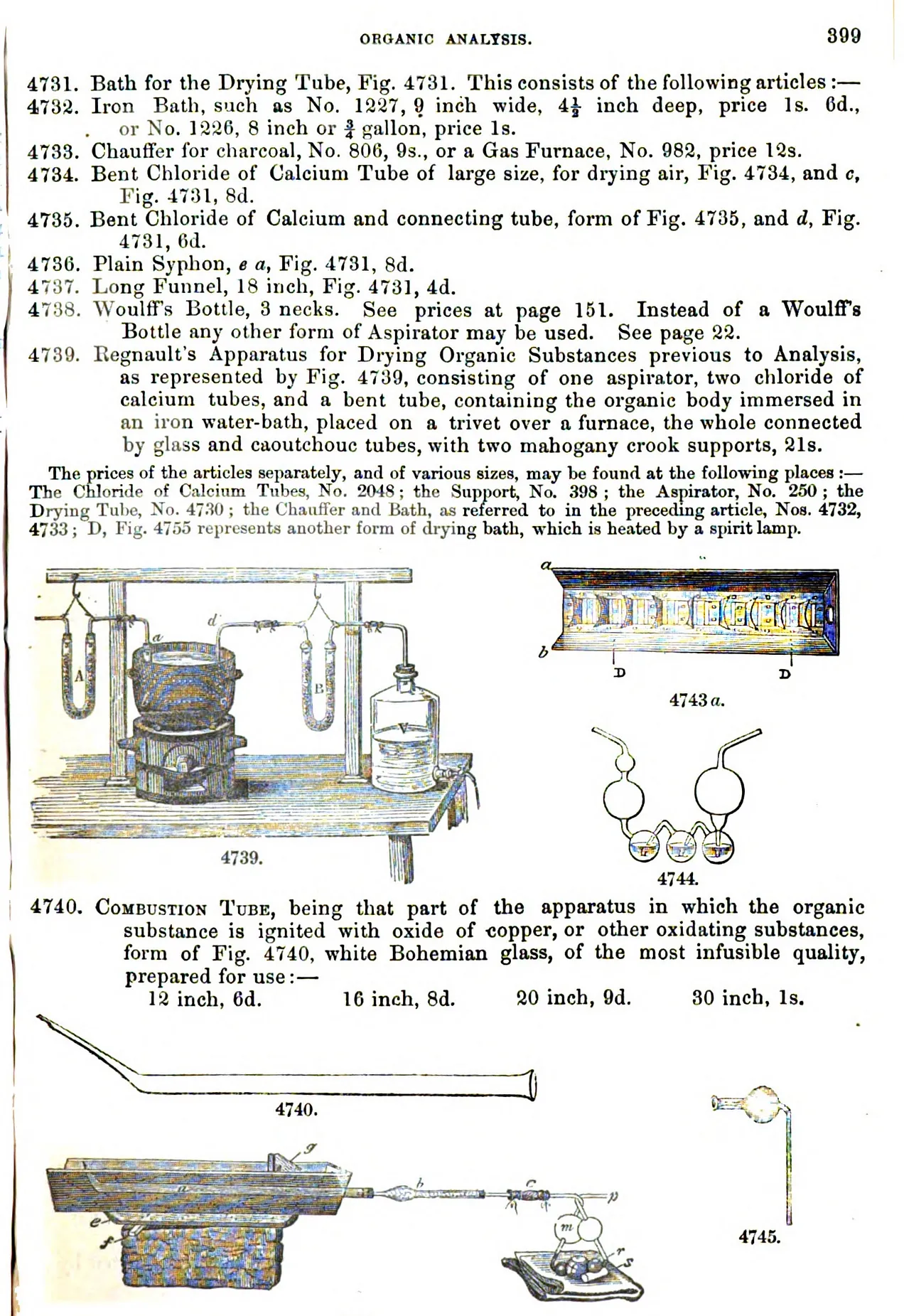
While Liebig’s proselytizing encouraged chemists to learn glassmaking, it also helped that glass itself was so cheap and easy to make. Glassmaking materials (silica sand, soda ash, and limestone) were readily available. As a result, glassblowing became professionalized. Entire lab glassware catalogs sprang up, many of which contained both prices and instructions on how to make one’s own instruments.
One prominent glass dealer was English chemist and publisher John Joseph Griffin, who in his 1832 book Chemical Reactions promoted the use of tumblers (later known as “Griffin beakers”). As the need for professional lab glassware suppliers emerged, Griffin established a shop in Covent Garden in 1852. By the time he published his 1866 lab equipment catalog, it included an adaptation of the Kaliapparat. For one shilling and sixpence, a chemist could purchase “Liebig’s Potash Apparatus,” complete with furnace, combustion tube, desiccant chamber, Kaliapparat, and vulcanized caoutchouc (rubber) connectors. For two shillings and sixpence, a specially modified Kaliapparat, made by professional glassblower Heinrich Geissler, was also available.
This modified device, just one of many similar tools that Geissler invented in the latter half of the 19th century, was designed such that it could be set upright on a tabletop. (Liebig’s triangular design, intended to be suspended from a scale, would simply fall over if set on a surface.) Beyond its basic geometry, Geissler made refinements to increase the Kaliapparat’s accuracy, adding integrated desiccant tubes as well as embedding little glass discs within its three glass bulbs, which forced the combustion fumes to bubble more vigorously (and therefore react more fully) as they passed through the potassium hydroxide.
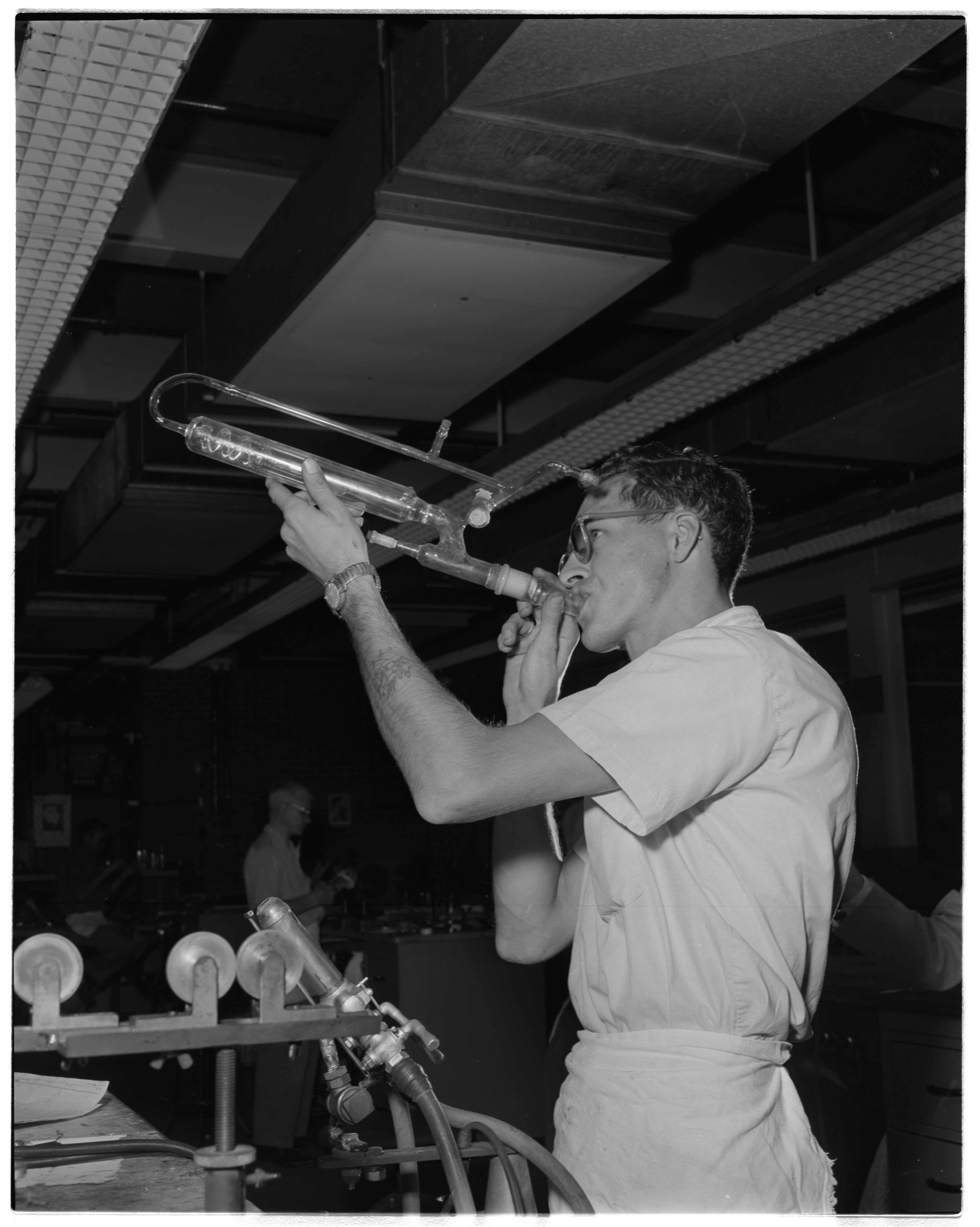
Geissler’s Kaliapparat is especially striking considering how difficult it would have been to fashion in 1866. At the time, a glassblower’s flame was not made by compressed propane and oxygen, as they are today, but by simply blowing air over an alcohol or oil lamp — or, in some cases, over a charcoal fire. “You were either using your breath or a foot bellows,” choreographing hands, mouth, and feet to generate temperatures in excess of 700°C, says Tracy Drier, a master glassblower at the University of Wisconsin. Today’s glassblowers work with oxy-propane torches that render such contortions obsolete, a convenience Liebig and Geissler could not have imagined.
Liebig and Geissler would have also been struck by the material properties of Tracy’s glass, as the glass formulations of their day left much to be desired. Both soda-lime formulations and leaded glass were vulnerable to attack by water and acids, and would become pitted and cloudy after repeated use. They also needed to be carefully handled and were sensitive to sharp changes in temperature. Even Bohemian potash glass, known for being colorless and fairly workable, contained impurities (iron contamination could introduce a faint greenish tinge) as well as bubbles, seeds, and striations (thin waviness from incomplete melting and mixing).
Perhaps unsurprisingly, the features of glass that late-19th-century scientists desperately wanted to improve upon were its optical qualities. This was especially true for those working in the burgeoning laboratory sciences that relied heavily on microscopes. And the key to better microscopes was better lenses — a technology which was being developed primarily in Jena, a town just 250 kilometers west of Giessen.
One of the major challenges lenses contend with is light dispersion. When light passes through glass, different frequencies bend by different amounts (the same phenomenon that creates rainbows in prisms). Dispersion is not an issue for lab glassware. A chemist wouldn’t care much if their Kaliapparat were to create little rainbows on their workbench. But in the nineteenth century, developments in the glass industry tended to come from optics (a big market) rather than beakers (a relatively small one). In a microscope or telescope, dispersion results in blurry, unfocused images as the light’s constituent parts fail to converge at a single focal point.
It was the chemist Otto Schott who took up the creation of low-dispersion glass. Schott grew up in the glass factory his father managed and later studied the chemistry of glass at the University of Jena. When he completed his degree in 1875, he returned home to Witten, where he kept working on glass formulations, and in 1879, managed to melt a batch with especially high lithium content. Confident that he had found a low-dispersion formulation, he sent a sample to Ernst Abbe, a professor at Jena who had been advocating for a systematic study of glass’s optical qualities.
Taken by the young Schott’s enthusiasm, Abbe invited Schott back to Jena to join him and microscope-maker Carl Zeiss in forming the Glass Technology Research Station. The collaboration, credited as “one of the greatest and most productive associations in the history of glass composition,” proved immensely fruitful. Before he had even moved to Jena, Schott succeeded in producing what he called “borate glass,” which contained high amounts of boric acid. Abbe, measuring the optical properties of this sample, wrote Schott to say that the new sample had “solved completely” the issues caused by dispersion.
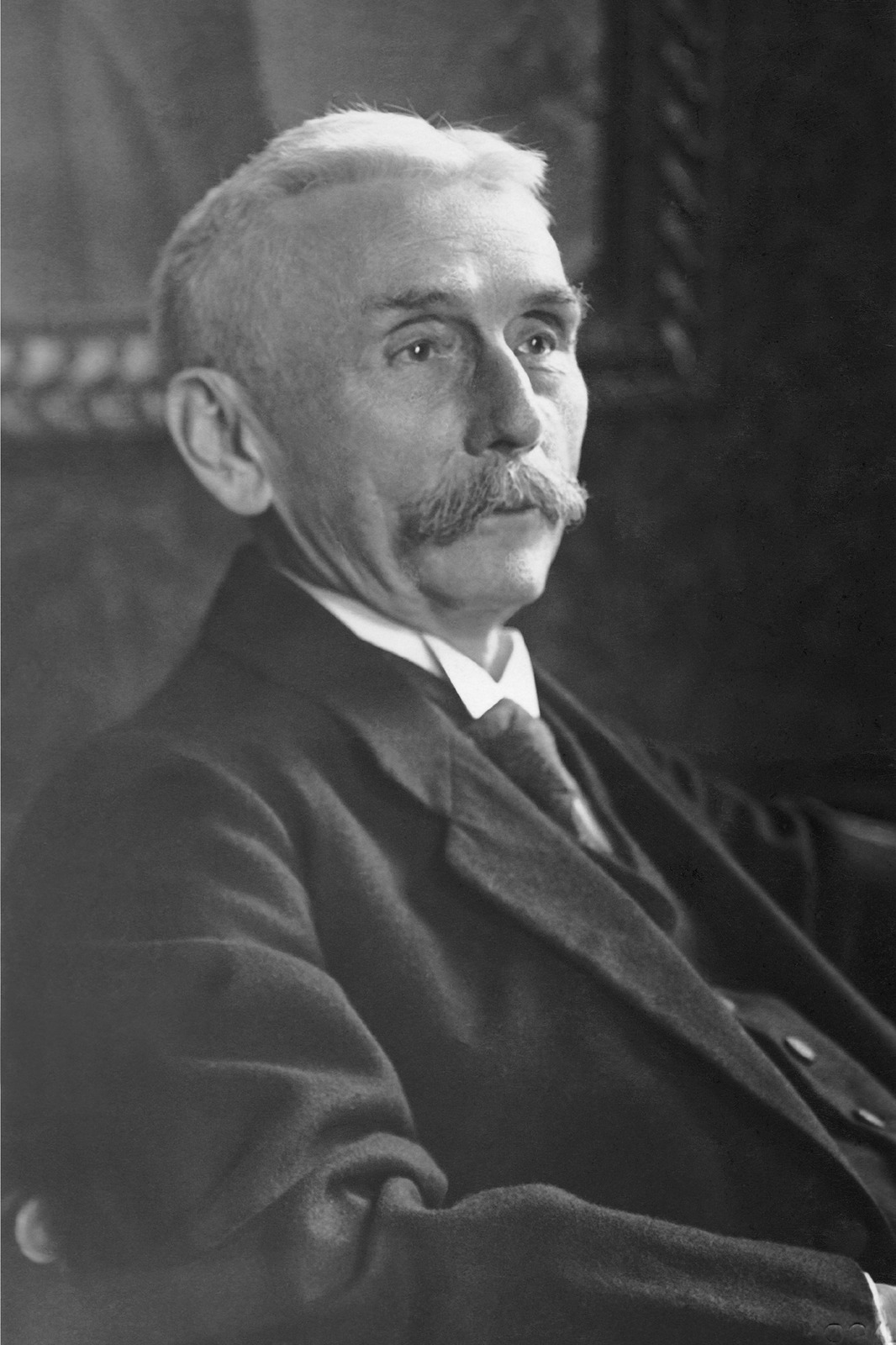

If the features of soda-lime glass are remarkable, then those of Schott’s borate glass — later known as borosilicate — were simply fantastic. In addition to its low dispersion, the borosilicates he developed in the 1880s were harder, more thermally stable, and more resistant to corrosion than soda-lime glasses. Each of these properties led to better lens performance. Increased hardness meant that borosilicates could be ground and polished more precisely, resulting in denser surfaces that reduced scattering. Borosilicate’s thermal stability — its tendency not to swell much when heated — meant that fewer internal stresses were created during the grinding and polishing process, resulting in a more homogeneous refractive index. And its excellent environmental stability meant that it didn’t corrode when exposed to air, water, and other chemicals (a problem rare in today’s glass, but painfully evident in antique glassware).
Borosilicate is also much more elastic than soda-lime glass, resulting in lenses (and later lab glassware) that could withstand whatever bumps and jostles they would inevitably experience in the laboratory. Schott, Ernst Abbe, and Carl Zeiss would go on to develop dozens of varieties of optical borosilicate glass; by 1886, they were selling 44 different varieties.
While optical glass has been heralded as “one of the key materials of civilization,” the creation of “utensil glass” would become the real workhorse of the modern laboratory. Schott first produced it in 1892, noting in his journal that “introduction of a boric acid content of up to 25 percent” resulted in glass that could be “manufactured into objects subject to thermal shocks or required to compensate for large temperature differences through the wall. Such objects are: boiling flasks, beakers, [and] bowls for chemists.”
Incredibly, his new formulation was rejected by the German patent office, which cited his earlier wares as being similarly durable. Schott tried, and failed, to appeal their ruling, but in the end, he found satisfaction through commercial success instead. And the new formulation, introduced to the market in the winter of 1893-1894, became the standard for lab glassware almost immediately. By the first years of the 20th century, Schott was selling not only “boiling flasks, Erlenmeyer flasks and beakers” but also “round-bottomed flasks, measuring flasks, Kjeldahl flasks, retorts, fractional distillation flasks, evaporating dishes, test bottles and tubes.”
Schott’s advancements quickly made Jena the heart of the glassblowing world. In Germany, both “Jena” and “Schott” would become household names, with streets and even sports facilities paying tribute to the venerated glassblower. And their reach was not confined to central Europe: Because lab glassware was classified as an educational product, it was often exempt from U.S. import duties, allowing the established German industry to outcompete the younger American one for more than a decade. Those living in the U.S. in 1910 would likely purchase their Kaliapparats from a German manufacturer.
This changed in the summer of 1914 — the onset of WWI — when the British blockade prevented German-made goods from reaching U.S. shores. According to a 1917 Bureau of Standards report, the blockade caused “a very serious shortage of glassware.” With German glass immobilized, however, the market was flooded with new domestic entrants. To promote these brands to American chemists, the Bureau of Standards tested five national lab glassware brands and compared them to Jena and Kavalier, the two German brands that had been most commonplace in the years leading up to WWI. Only one of the American companies, Libbey, predated the invention of borosilicate glass (originally founded in 1818 in Cambridge, Massachusetts, as the New England Glass Company, before relocating to Ohio in 1888 and renaming to Libbey Glass Co).
It was the newest entrant to the market — a Corning, New York brand called “Pyrex” — that performed best of all. Pyrex ware had an “unusually low” coefficient of expansion, and its chemical resistance showed “slight superiority” over all but the Libbey sample. The Corning company, already producing pie pans and casseroles under the Pyrex name, was off to the races. By 1916, they were producing beakers, flasks, and glass tubing, and by 1918, the word “Pyrex” was more common than “borosilicate.” By 1927, use of the word “Pyrex” went on to surpass “Kodak.”
This period was undoubtedly the golden age of glassware. During the 1920s and 1930s, a series of glassware providers established standardized ground fittings, allowing chemists to piece together different glass apparatus without the use of corks and rubber connecting hoses. These acted as a single, standard interface design, letting chemists quickly assemble modular experimental setups. Standard ground fittings quickly gained popularity, and in 1930, they were adopted as “CS 21-36” by the U.S. National Bureau of Standards. By 1938, the Pyrex glassware catalog was 130 pages long. Throughout their product line, all connections were compatible with CS 21-36 Standard Taper fittings.
Such fittings were only one innovation among many aimed at greater precision. Until the 20th century, most glassware (even that based on the same design) wasn’t exactly the same size and volume. While glass molds had existed since the first century to help with consistency, minor variation between vessels remained. This was usually addressed by individual calibration. Each volumetric flask or beaker was filled with distilled water at a controlled temperature — typically 20°C — and the water was carefully weighed on a precision scale. Using the known density of water at that temperature, the glassblower could calculate the true volume and etch the calibration mark at the right spot on that particular piece of glass. This meant that two half-liter flasks might have their calibration lines at slightly different heights, but both would contain precisely 500 mL when filled to their respective marks.
During this “golden age,” however, the development of precision-machined metal molds, combined with Otto Schott’s borosilicate glass, which expanded minimally with temperature changes, meant that glassware could be manufactured to consistent dimensions batch after batch.
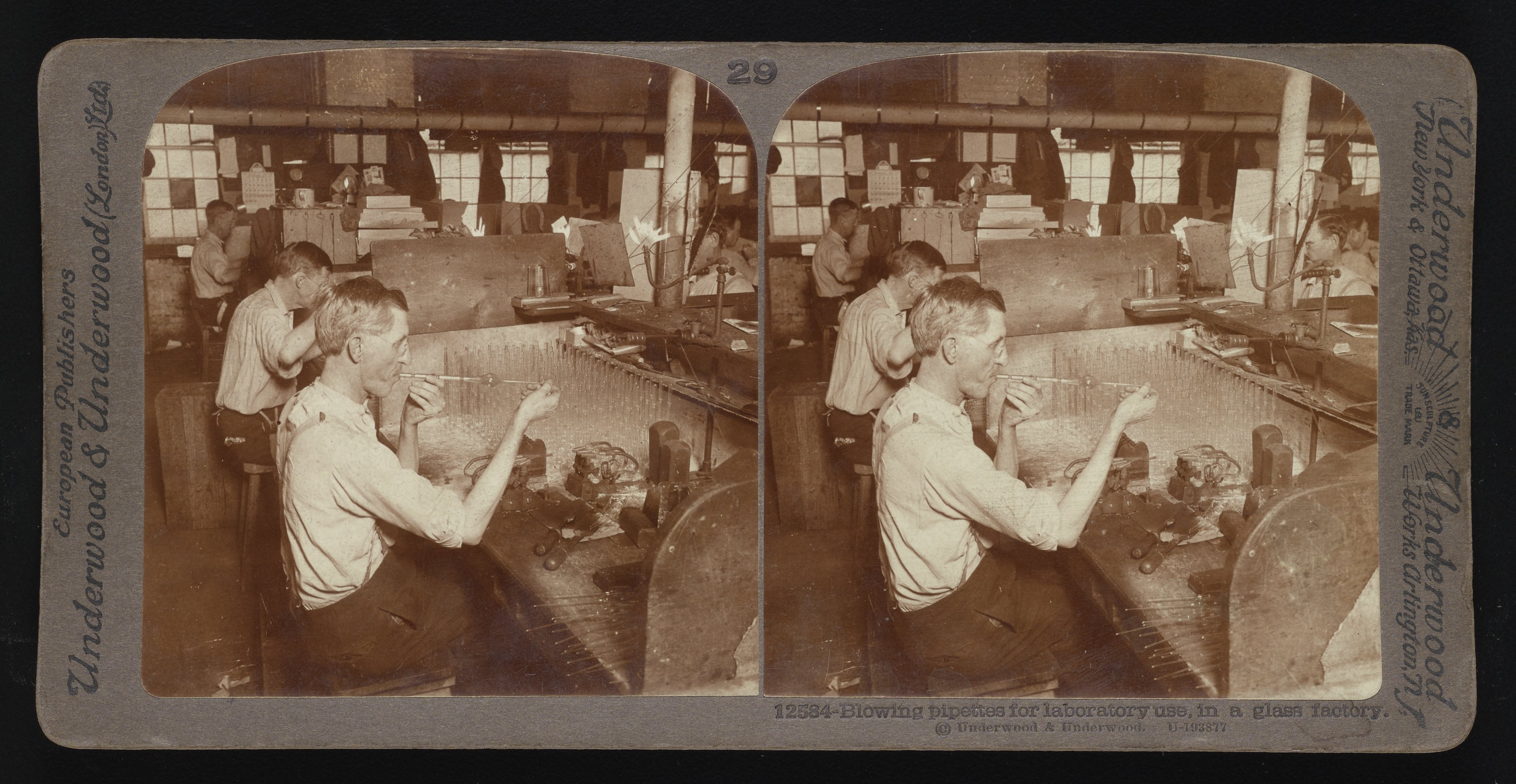
Despite the proliferation of standardized glassware and instruments, working chemists were still expected to blow at least some of their own. Even in the early 20th century, this was a required skill for PhD candidates at the University of Wisconsin, and glassblowing classes were common parts of four-year chemistry degrees through the 1950s, when trade schools began offering specialty degrees in the subject. During this time, it was not unheard-of for major biotech companies to outfit (but not staff) their own glass shops, with the expectation that working chemists would produce their own supply. As late as 1957, chemistry textbooks contained instructions on how to work glass with flame.
Today, however, most chemists have given up making their own equipment. And glassblowing, once considered a craft essential to the science of chemistry, has become a subcontracted trade. Even so, the material itself remains centrally important: while plastic has made inroads into the laboratory in the form of sterile, inexpensive components like pipette tips, polystyrene tissue culture flasks, petri dishes, and multi-well plates, glass remains key in optical and high-temperature applications.
Jena, too, remains synonymous with glass, today known as “The City of Science and Light.” While the headquarters of Scott AG moved after WWII to Mainz in West Germany, the company maintains major operations in Jena, producing everything from optical fibers and ceramic glass to the deeply practical glassware championed by Schott, Abbe, and that extraordinary professor of chemistry himself, Justus Liebig.
Spencer Wright is a writer and ersatz engineer living in Brooklyn, New York. Since 2013, he has written the newsletter Scope of Work, which these days vacillates between technical deep dives and essays about living in New York, rewiring thermostats, and explaining photons to six-year-olds.
Acknowledgements: Thanks to Tracy Drier for granting us an interview, and also to Catherine Jackson, whose book Molecular World provided an incredible overview of Liebig’s work. I also sourced extensively from Jackson’s “The Wonderful Properties of Glass,” Liebig’s Kaliapparat and the Practice of Chemistry in Glass, and Jürgen Steiner’s Otto Schott And The Invention Of Borosilicate Glass.
Cite: Wright, S. “Working in Glass.” Asimov Press (2026). DOI: 10.62211/79pj-25qs
- Carbon dioxide is typically measured by volume rather than weight because it is a gas at room temperature. To weigh CO₂, then, one must contain it in a vessel and account for the container’s weight, correct for buoyancy effects (since the denser-than-air gas displaces surrounding air that exerts an upward force), and control for temperature and pressure variations that significantly affect gas density. In contrast, measuring volume is straightforward: one can collect CO₂ in a graduated cylinder, syringe, or gas collection apparatus and read the volume directly. ↩
- Although morphine was a natural choice in that it was widely pharmaceutically available and contained only a small amount of nitrogen, it was also a “high-stakes choice,” according to historian Catherine Jackson in her book Molecular World. “The best previous analysis of morphine had been published in 1823 by Jean Baptiste Dumas and Pierre Joseph Pelletier,” a “rising star of Parisian chemistry” and a “one of the most respected pharmaceutical chemists in Paris, codiscoverer of quinine and several other medicinally valuable alkaloids,” respectively. ↩