%20!important%3B%22%2F%3E%0A%3Cpath%20d%3D%22M58.9724%2026.1292C57.6595%2026.1292%2055.9552%2025.7092%2054.1179%2024.896L54.1958%2021.3279H54.591C55.6132%2024.423%2057.4239%2025.3179%2058.9971%2025.3179C60.4411%2025.3179%2061.412%2024.5579%2061.412%2023.2184C61.412%2021.6186%2059.8369%2021.1455%2057.8172%2020.3323C55.4555%2019.3614%2054.04%2018.4437%2054.04%2016.5323C54.04%2014.1972%2055.902%2012.6753%2058.79%2012.6753C60.2717%2012.7131%2061.7288%2013.062%2063.0669%2013.6994L62.9871%2017.0567H62.5672C61.754%2014.1972%2060.1808%2013.4885%2058.7672%2013.4885C57.2187%2013.4885%2056.2231%2014.3017%2056.2231%2015.4569C56.2231%2016.899%2057.8761%2017.2657%2060.2131%2018.2366C62.0238%2018.9453%2063.5989%2019.8116%2063.5989%2022.0935C63.5913%2024.6547%2061.6324%2026.1292%2058.9724%2026.1292Z%22%20fill%3D%22%23123236%22%20style%3D%22fill%3A%20rgb(18%2C%2050%2C%2054)%20!important%3B%22%2F%3E%0A%3Cpath%20d%3D%22M63.8701%2025.5209C65.0234%2025.4164%2065.9601%2025.0744%2065.9601%2023.2637V15.4471C65.9601%2013.6364%2065.0101%2013.2944%2063.8891%2013.1899V12.8289H68.6106V23.2695C68.6106%2025.0801%2069.5606%2025.4221%2070.7101%2025.5266V25.8933H63.8701V25.5209ZM65.1298%209.1809C65.1368%208.71493%2065.3284%208.27077%2065.6625%207.9459C65.9967%207.62104%2066.446%207.44208%2066.912%207.44817C67.3783%207.44157%2067.8282%207.62033%2068.1627%207.94525C68.4973%208.27017%2068.6891%208.7146%2068.6961%209.1809C68.6954%209.41374%2068.6485%209.64416%2068.5583%209.8588C68.468%2010.0734%2068.3362%2010.2681%2068.1703%2010.4315C68.0044%2010.5949%2067.8078%2010.7238%2067.5919%2010.8108C67.3759%2010.8979%2067.1448%2010.9412%2066.912%2010.9384C66.4428%2010.9389%2065.9923%2010.7543%2065.6586%2010.4244C65.3248%2010.0946%2065.1348%209.64629%2065.1298%209.1771V9.1809Z%22%20fill%3D%22%23123236%22%20style%3D%22fill%3A%20rgb(18%2C%2050%2C%2054)%20!important%3B%22%2F%3E%0A%3Cpath%20d%3D%22M85.9783%2025.521C86.9492%2025.4165%2087.7358%2025.0746%2087.7358%2023.2639V17.1516C87.7358%2015.3162%2086.6604%2014.503%2085.3741%2014.503C84.4241%2014.503%2083.5387%2014.9476%2082.6989%2015.8919C82.7255%2016.1807%2082.7521%2016.4961%2082.7521%2016.8115V23.2715C82.7521%2025.0822%2083.5387%2025.4241%2084.5096%2025.5286V25.8954H78.3707V25.5286C79.3416%2025.4241%2080.1282%2025.0822%2080.1282%2023.2715V17.1592C80.1282%2015.3238%2079.0775%2014.5106%2077.7665%2014.5106C76.8165%2014.5106%2075.9824%2014.9552%2075.1426%2015.8995V23.2715C75.1426%2025.0822%2075.9311%2025.4241%2076.9799%2025.5286V25.8954H70.499V25.5286C71.601%2025.4241%2072.494%2025.0822%2072.494%2023.2715V15.4549C72.494%2013.6442%2071.601%2013.3022%2070.499%2013.1977V12.8291H75.1426V15.1908C76.1933%2013.5378%2077.5043%2012.6714%2079.1041%2012.6714C80.7039%2012.6714%2082.0947%2013.5112%2082.5678%2015.3219C83.6698%2013.5891%2085.0378%2012.6714%2086.687%2012.6714C88.6535%2012.6714%2090.3863%2014.0014%2090.3863%2016.8172V23.2772C90.3863%2025.0879%2091.2508%2025.4299%2092.3015%2025.5344V25.901H85.9783V25.521Z%22%20fill%3D%22%23123236%22%20style%3D%22fill%3A%20rgb(18%2C%2050%2C%2054)%20!important%3B%22%2F%3E%0A%3Cpath%20d%3D%22M98.5056%2026.0987C95.1217%2026.0987%2092.209%2023.5014%2092.209%2019.329C92.209%2015.1566%2095.1217%2012.6658%2098.5056%2012.6658C101.889%2012.6658%20104.829%2015.1851%20104.829%2019.329C104.829%2023.4729%20101.889%2026.0987%2098.5056%2026.0987ZM95.1996%2019.329C95.1996%2022.2949%2096.1705%2025.3368%2098.5056%2025.3368C100.841%2025.3368%20101.838%2022.3196%20101.838%2019.329C101.838%2016.3384%20100.814%2013.4276%2098.5056%2013.4276C96.1971%2013.4276%2095.1996%2016.365%2095.1996%2019.329Z%22%20fill%3D%22%23123236%22%20style%3D%22fill%3A%20rgb(18%2C%2050%2C%2054)%20!important%3B%22%2F%3E%0A%3Cpath%20d%3D%22M106.111%2015.2991C105.402%2013.6195%20104.669%2013.3041%20103.855%2013.1996V12.8291H110.315V13.1958C109.162%2013.3269%20108.453%2013.6955%20109.109%2015.2953L112.073%2022.483L114.959%2015.2953C115.616%2013.6423%20114.723%2013.3003%20113.648%2013.1958V12.8291H118.187V13.1958C117.321%2013.3003%20116.508%2013.6423%20115.825%2015.3219L111.602%2025.8878H110.578L106.111%2015.2991Z%22%20fill%3D%22%23123236%22%20style%3D%22fill%3A%20rgb(18%2C%2050%2C%2054)%20!important%3B%22%2F%3E%0A%3Cpath%20d%3D%22M122.474%2025.4944C123.68%2025.3899%20124.678%2025.0232%20124.678%2023.1327V9.7529C124.678%207.8643%20123.68%207.49761%20122.474%207.39311V6.99976H131.261C134.936%206.99976%20137.506%209.49065%20137.506%2012.7434C137.506%2016.3914%20134.466%2018.5689%20130.737%2018.5689H127.588V23.1289C127.588%2025.0289%20128.613%2025.3861%20129.792%2025.4906V25.8839H122.474V25.4944ZM127.588%2017.7291H130.248C132.846%2017.7291%20134.446%2015.4737%20134.446%2012.7434C134.446%2010.0948%20132.977%207.83768%20130.406%207.83768H127.598L127.588%2017.7291Z%22%20fill%3D%22%23123236%22%20style%3D%22fill%3A%20rgb(18%2C%2050%2C%2054)%20!important%3B%22%2F%3E%0A%3Cpath%20d%3D%22M137.533%2025.5207C138.635%2025.4162%20139.553%2025.0743%20139.553%2023.2636V15.4469C139.553%2013.6362%20138.635%2013.2943%20137.533%2013.1898V12.8288H142.23V17.0258C142.832%2014.5084%20144.852%2012.2512%20147.449%2012.7756L147.056%2015.4793H146.866C144.713%2014.5863%20142.589%2016.1613%20142.222%2019.2032V23.2693C142.222%2025.08%20143.14%2025.422%20144.242%2025.5265V25.8931H137.525L137.533%2025.5207Z%22%20fill%3D%22%23123236%22%20style%3D%22fill%3A%20rgb(18%2C%2050%2C%2054)%20!important%3B%22%2F%3E%0A%3Cpath%20d%3D%22M153.488%2026.0987C150.366%2026.0987%20147.533%2023.6591%20147.533%2019.3557C147.533%2015.2631%20149.946%2012.6658%20153.332%2012.6658C156.794%2012.6658%20158.709%2015.3941%20158.682%2018.9623H150.322C150.4%2022.5571%20152.184%2024.4458%20154.493%2024.4458C155.937%2024.4458%20157.326%2023.7636%20158.403%2022.3728L158.717%2022.4508C158.326%2023.5228%20157.614%2024.4484%20156.679%2025.1012C155.743%2025.754%20154.629%2026.1023%20153.488%2026.0987ZM150.34%2018.2023H155.954C155.876%2015.7608%20154.958%2013.4523%20153.252%2013.4523C151.417%2013.4523%20150.473%2015.9451%20150.34%2018.2023Z%22%20fill%3D%22%23123236%22%20style%3D%22fill%3A%20rgb(18%2C%2050%2C%2054)%20!important%3B%22%2F%3E%0A%3Cpath%20d%3D%22M164.817%2026.1292C163.506%2026.1292%20161.8%2025.7092%20159.964%2024.896L160.042%2021.3279H160.432C161.456%2024.423%20163.265%2025.3179%20164.84%2025.3179C166.282%2025.3179%20167.253%2024.5579%20167.253%2023.2184C167.253%2021.6186%20165.68%2021.1455%20163.658%2020.3323C161.298%2019.3614%20159.881%2018.4437%20159.881%2016.5323C159.881%2014.1972%20161.743%2012.6753%20164.631%2012.6753C166.113%2012.7128%20167.57%2013.0618%20168.908%2013.6994L168.83%2017.0567H168.412C167.599%2014.1972%20166.024%2013.4885%20164.612%2013.4885C163.063%2013.4885%20162.066%2014.3017%20162.066%2015.4569C162.066%2016.899%20163.719%2017.2657%20166.056%2018.2366C167.867%2018.9453%20169.44%2019.8116%20169.44%2022.0935C169.434%2024.6547%20167.462%2026.1292%20164.817%2026.1292Z%22%20fill%3D%22%23123236%22%20style%3D%22fill%3A%20rgb(18%2C%2050%2C%2054)%20!important%3B%22%2F%3E%0A%3Cpath%20d%3D%22M175.374%2026.1292C174.061%2026.1292%20172.357%2025.7092%20170.519%2024.896L170.597%2021.3279H170.992C172.015%2024.423%20173.825%2025.3179%20175.398%2025.3179C176.842%2025.3179%20177.813%2024.5579%20177.813%2023.2184C177.813%2021.6186%20176.238%2021.1455%20174.219%2020.3323C171.857%2019.3614%20170.441%2018.4437%20170.441%2016.5323C170.441%2014.1972%20172.303%2012.6753%20175.191%2012.6753C176.673%2012.7131%20178.13%2013.062%20179.468%2013.6994L179.388%2017.0567H178.969C178.155%2014.1972%20176.582%2013.4885%20175.169%2013.4885C173.62%2013.4885%20172.625%2014.3017%20172.625%2015.4569C172.625%2016.899%20174.278%2017.2657%20176.615%2018.2366C178.425%2018.9453%20180%2019.8116%20180%2022.0935C179.991%2024.6547%20178.022%2026.1292%20175.374%2026.1292Z%22%20fill%3D%22%23123236%22%20style%3D%22fill%3A%20rgb(18%2C%2050%2C%2054)%20!important%3B%22%2F%3E%0A%3Cpath%20d%3D%22M22.4922%2011.2518C22.4892%208.37895%2021.3888%205.61569%2019.4159%203.52733C17.4431%201.43898%2014.7468%200.183268%2011.8788%200.0170703V0H10.6134V0.0170703C7.74531%200.183268%205.04911%201.43898%203.07625%203.52733C1.10338%205.61569%200.00294138%208.37895%200%2011.2518V33.1189H0.632691C2.96479%2033.1153%205.2383%2032.388%207.13939%2031.0372C9.04048%2029.6864%2010.4754%2027.7789%2011.2461%2025.5778C12.018%2027.7776%2013.4533%2029.6838%2015.3543%2031.0335C17.2553%2032.3832%2019.5281%2033.1097%2021.8595%2033.1131H22.4922V11.2518ZM21.2268%2011.2518C21.2224%2013.7878%2020.2544%2016.2273%2018.5187%2018.0762C16.783%2019.9252%2014.4094%2021.0453%2011.8788%2021.2096V1.27869C14.4122%201.44322%2016.7882%202.56537%2018.5246%204.41749C20.261%206.26962%2021.2277%208.71304%2021.2287%2011.2518H21.2268ZM1.26731%2031.8287V11.2518C1.26878%208.71426%202.23567%206.27223%203.97174%204.42148C5.70781%202.57073%208.083%201.44987%2010.6153%201.2863V21.8746C10.6096%2024.4098%209.64093%2026.8482%207.90542%2028.6963C6.16991%2030.5443%203.79715%2031.664%201.26731%2031.8287ZM21.2287%2031.8287C18.8025%2031.6704%2016.5171%2030.6333%2014.8004%2028.9116C13.0836%2027.1899%2012.0531%2024.9017%2011.9016%2022.4751C13.8477%2022.3595%2015.7303%2021.7405%2017.3653%2020.6787C19.0003%2019.6169%2020.3315%2018.1487%2021.2287%2016.4179V31.8287Z%22%20fill%3D%22%23123236%22%20style%3D%22fill%3A%20rgb(18%2C%2050%2C%2054)%20!important%3B%22%2F%3E%0A%3C%2Fsvg%3E)

Published research papers are far from literal accounts of the process of scientific discovery. In contemporary scientific practice, once publishable results are obtained, the actual path taken to reach them becomes more or less irrelevant. Dead ends and false trails are omitted, and out of the messy process of raw research emerges a coherent narrative following clean, linear lines of argument.
But in the space between the hands-on, physical reality of experimental science and the structured narratives fit for printed journals, sits a special genre of scientific writing: lab notebooks. They are the closest witness to “science in the making” (short of live video recordings, which only became available at scale recently).
Historically, scientists recorded ideas and experiments in their lab notebooks with a very restricted audience in mind, sometimes just their colleagues within a research group. For this reason, though some are distinguished by a more literary style and read almost like diaries, most of these records are highly abbreviated and undecipherable to outsiders.
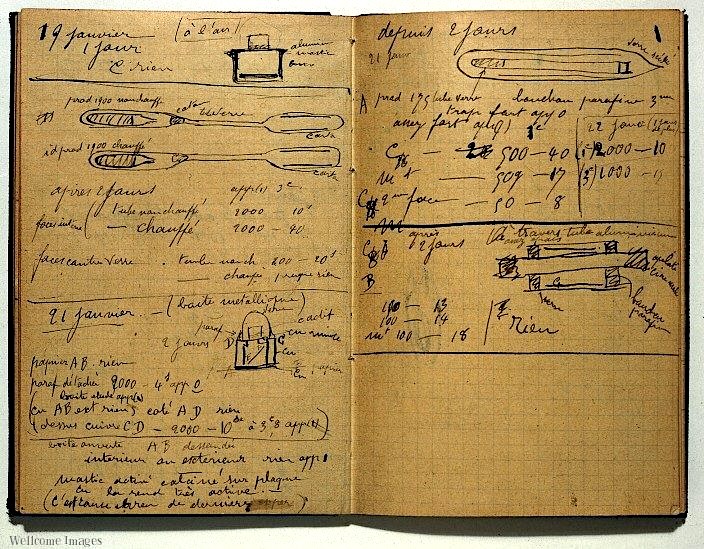
The origins of lab notebooks in experimental science can be traced back to the Renaissance humanist practices1 of copying excerpts from texts to create repositories of proverbs, quotations and miscellaneous facts in personal, thematically organized “commonplace” notebooks. In grammar schools, students were encouraged to develop their notetaking skills, collecting extracts from classical Latin authors. Natural philosophers such as Robert Boyle, John Aubrey, John Ray, and Robert Hooke adopted and repurposed these practices, making meticulous records of their own empirical investigations, while also keeping traditional commonplace books.
The naturalist John Ray’s Collection of English Proverbs(1670) was based on copious notebooks of proverbs extracted from printed catalogues, his own observations of “familiar discourse” and contribution sent to him by “learned and intelligent persons.” Some of the proverbs were accompanied by Ray’s own empirical observations contradicting the proverbs’ claims. For example, the proverb…
If the grass grows in Janiveer, it grows the worse sor’t all year
…is followed by Ray’s qualifier:
There is no general rule without some exception: for in the year 1677 the winter was so mild, that the pastures were very green in January, yet was there scarce ever known a more plentiful crop of hay then the summer following.2
The rise of early modern science was thus deeply influenced by humanist inquiry. Notebooks were used in both traditional and novel ways, as memory aids and as records of information to be communicated later. In Notebooks, English Virtuosi, and Early Modern Science, historian of science Richard Yeo writes:
In the seventeenth century there was a conviction that, to a large extent, copious knowledge could be reliably stored and manipulated in memory. However, during the Scientific Revolution a contrary view was emerging: namely, that the advancement of natural knowledge entailed a reconfiguration of the balance between memory and other ways of storing information. It was accepted that the empirical sciences demanded large quantities of detailed information that needed to be recorded with precision, and kept as durable records to be shared and communicated.3
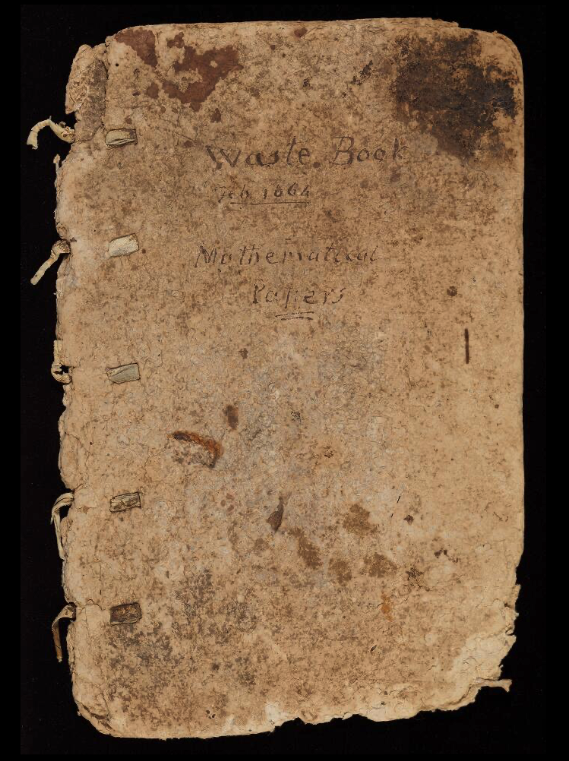
Isaac Newton’s famous Waste Book,4 currently kept at Cambridge University Library, is a rare example of a physical continuity between the two cultures of notetaking: humanist and scientific.5 It starts out as a commonplace book of excerpted scriptural commentary collected by his stepfather, reverend Barnabas Smith. In 1664, on a visit home in Lincolnshire, Newton found the deceased Smith’s partially used commonplace book and began adding his own prolific and inventive notes on mathematical problems and derivations and sketches of physical experiments.
In contrast to his stepfather, Newton didn’t just collect facts and excerpts: he used them as seeds of his own theoretical explorations. This way, the Waste Book served as an extension of his mind, rather than merely a memory aid, later becoming the foundation of his magnum opus Principia Mathematica. Throughout his life, Newton kept returning to the Waste Book again and again, and the notebook that reached us is quite decrepit from such abundant use.
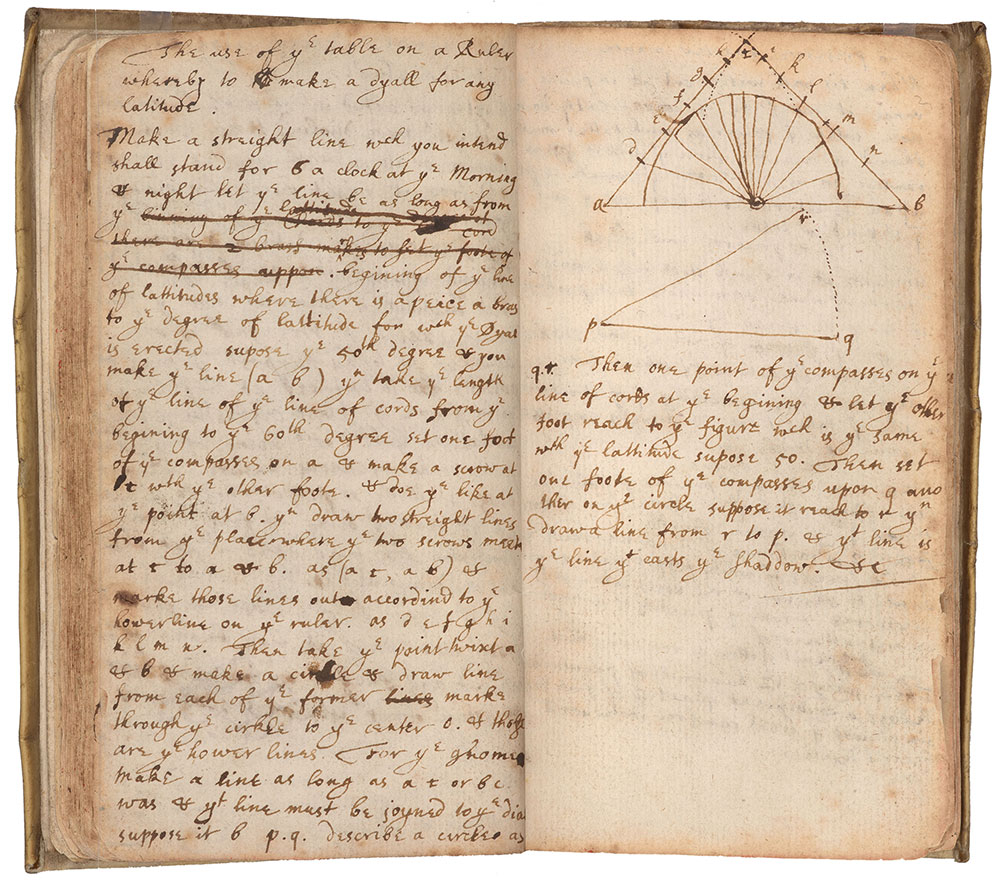
Newton’s later notebooks, from the 1670s to the 1690s, document his optical investigations in a series of mostly unbound notes.6 These epitomize the gap between private and public research records. Newton seemingly didn’t intend the notebooks to be a lasting record of his experiments as barely any raw data survives, except for some of his late experiments on diffraction. It appears that Newton discarded most of his raw experimental records after completing and writing up each study. In his experiments on thin films, the colors of thick plates, and diffraction, he proceeded from a hypothesis expressed as a mathematical model, to experimental design, to deducing general laws, then back to new drafts.
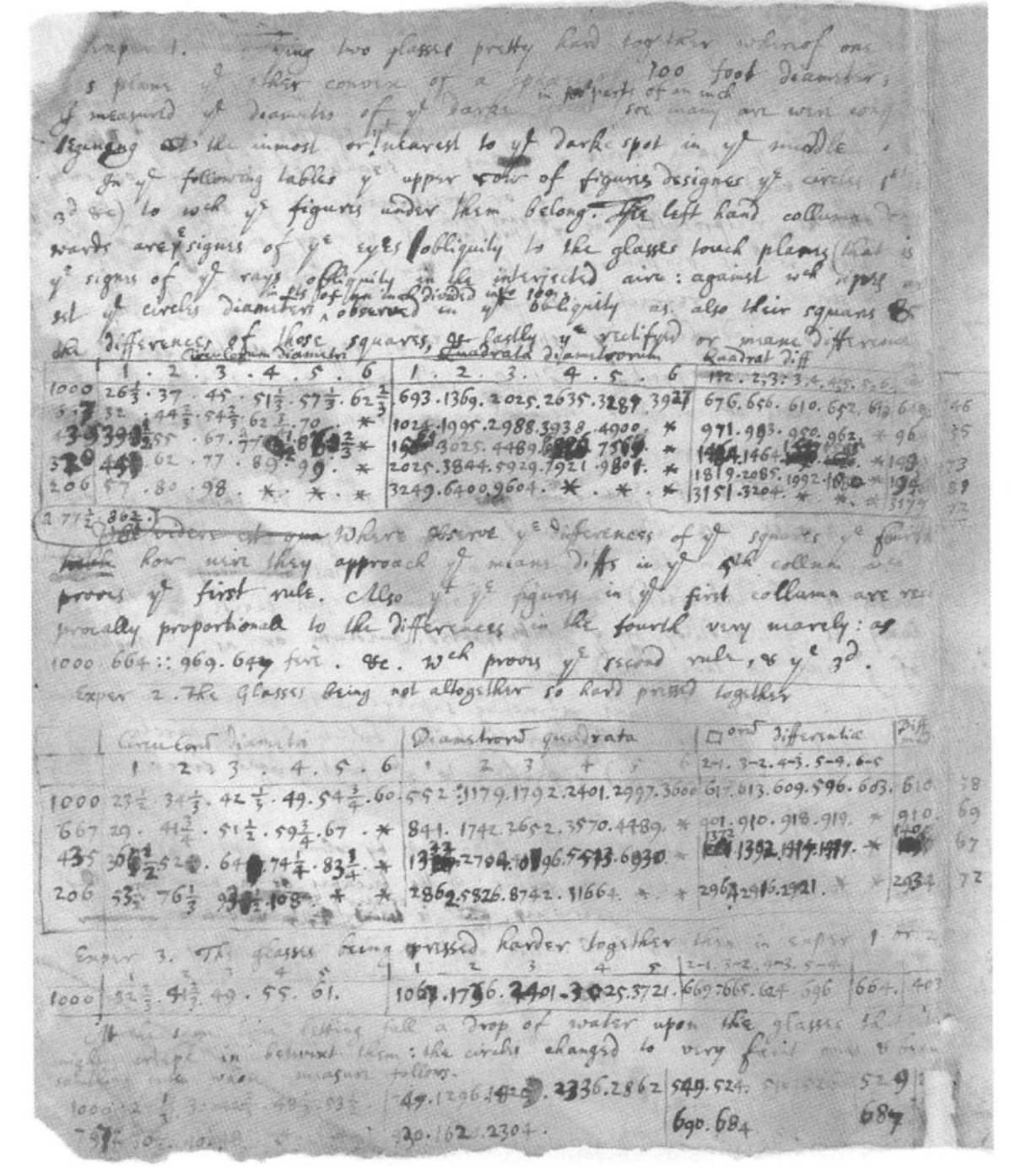
Newton’s “hypothesis-driven” (his term) experiments on colored circles in thin films are described in his notes under the title “ Of ye coloured circles twixt two contiguous glasses,” likely from 1671. Newton’s rings, as they are now known, are concentric, alternating bright and dark circles formed in the gap between a spherical lens and a flat glass surface, which are caused by the interference of light. Newton first wrote down a series of propositions about the properties of the colored circles, deduced by postulating the existence of hypothetical entities — light corpuscules. The first such proposition on the colored circles reads:
Prop 1. That their areas are in arithmeticall proportion, & soe thicknesse of interjected [film.] Or the spaces rays pass through twixt circle & circ[l]e are in arithm prop[ortion].
He then recorded the measurements of the diameters of the concentric circles and showed that their squares (and therefore, the areas of the circles) increase by a constant quantity — that is, they make up an arithmetic progression, just as stated in the first proposition.
In these and subsequent experiments, Newton made use of averages, a practice almost unheard of in seventeenth century experimental physics, though already in use in astronomy and navigation. The historian of science Richard S. Westfall noted how Newton elevated “quantitative science to a wholly new level of precision … He boldly transported the precision of the heavens into mundane physics … ”
In 1704, Newton published the results of these investigations in his monumental Opticks— in a highly polished form, however, omitting his workings through physical models and the relentless pursuit of precise measurements that populate his research notes. Like Galileo, Newton believed that mathematics was a source of greater certainty than natural philosophy and that natural laws were best expressed in a mathematical language. But his raw experimental data didn’t perfectly align with those laws, even though he managed to achieve remarkably high precision for his time (within 1 to 2 percent). Most intermediate steps of his research thus remain hidden from the readers of Opticks.
Newton also left extended commentary on a famous alchemical text, Introitus apertus ad occlusum regis palatium (An Open Entrance to the Closed Palace of the King).7 This book is attributed to George Starkey,8 a colonial American alchemist who moved from New England to London at age 22 and worked under the tutelage of Robert Boyle. The book is written in a veiled and heavily symbolic language featuring fiery dragons, rabid dogs, and Diana’s doves — traditional alchemical cover-names referring to specific chemical substances. This florid imagery, however, stands in stark contrast to Starkey’s private “chymical” notebooks,9 which are considered models of scholarly clarity. In their laboratories, alchemists seem to have preferred dry recipes with precise annotations, keeping the spectacle and symbolism for public presentation.
Starkey, a Harvard graduate, made extensive use of his scholastic training in documenting his alchemical experiments. Throughout his notebooks, recurring tags mark sequential steps in each experiment: Processus conjecturalis(conjectural process) , Conclusio probabilis(probable conclusion) , Quaere(search) , Observatio(observation) , Animadversio(animadversion, criticism) , igne refutata(refuted by fire (!), that is, rejected by empirical testing) . These are the kinds of annotations that he inherited from the educational culture of early Harvard.
At the center of Starkey’s investigations was, of course, the Philosopher’s Stone, or the Great Bezoar, the legendary and elusive alchemical substance that could turn any “base” metal like lead or copper into a precious one like gold or silver (it additionally was believed to serve as the elixir of life, granting eternal youth and immortality). In his Magnum Opus — in the original alchemical sense of the actual process of creating the Philosopher’s Stone — Starkey worked persistently to achieve higher efficiency in obtaining its supposed precursors, with recurring concerns about the cost of reagents he used. In spirit, Starkey’s work is quite close to modern pharmaceutical and industrial chemistry, and his notebooks attest to his clear-headedness and pragmatism as a practicing (al)chemist.
Two centuries later, historians of science observe at least two distinct lab notebook styles emerging: narrative and numerical. These are best illustrated by the notebooks of two pioneering English physicists, Michael Faraday and James Joule.
Michael Faraday started out as a bookbinder and then worked as a “chemical assistant” and amanuensis to Sir Humphry Davy at the Royal Institution of London.10 After Davy’s death in 1831, Faraday took over as the director of one of the most well-equipped laboratories in Europe, dedicating himself to the study of electromagnetism.
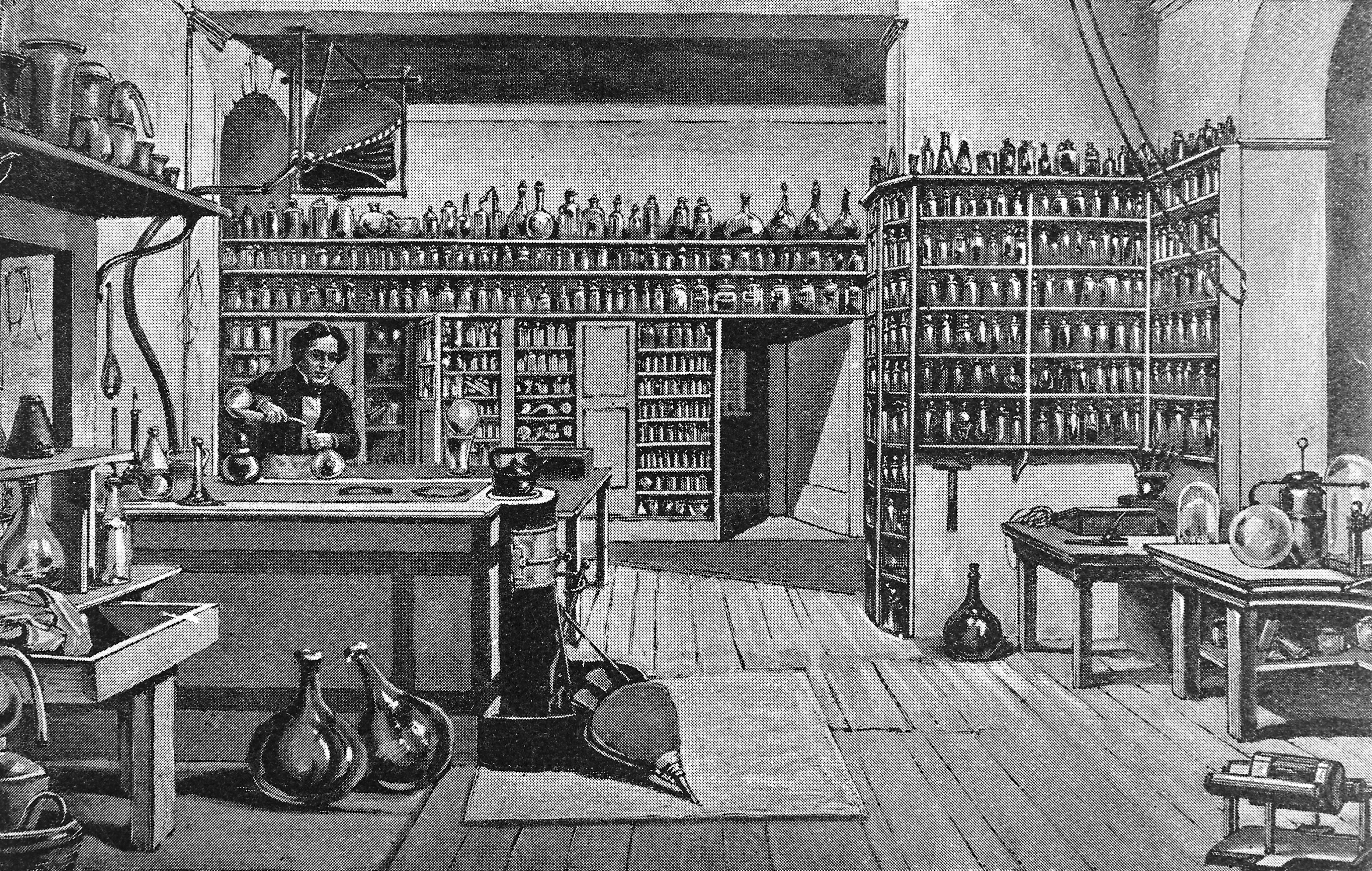

Faraday kept a detailed, narrative lab diary as a series of volumes he bound himself, spanning 42 years — 1820 to 1862.11 They contain records of about 30,000 experiments, both successful and unsuccessful.12 Entries between August 25, 1832, and March 6, 1860, are numbered from 1 to 16041. Each record includes a date, a description of the experimental setup, and results. Helpfully for historians of science, Faraday had the habit of marking with a vertical line the paragraphs in the lab diaries that made it into published papers, often unchanged. To some of the lab notes, he would add his interpretations of the results, new ideas to pursue, or a sign of excitement (as an exclamation mark). For raw ideas and speculations, he kept separate “idea books,” mostly dating from before 1830, at the beginning of his career.
Faraday’s copious notes served as compensation for his famously faulty memory. Even so, he repeated a previously completed experiment that he had apparently forgotten about more than once. (Such amusing occurrences of cryptomnesia are not uncommon among scientists).13
There are some signs that the notebook entries were made with some distance from the immediate action in the lab: Faraday’s handwriting is very neat, there are few corrections, and no chemical stains indicate contact with lab events. As the historian of science H. Otto Sibum puts it, many entries look like “the diary of a Victorian gentleman, written at the conclusion of an exciting day.”14 But Faraday also diligently recorded experimental failures and inaccurate measurements, so the notes appear to reflect the raw reality of his lab investigations.
When his lab diary eventually became too expansive, he added directories and indices to track its contents. This systematic and detailed approach to notetaking could be traced to Faraday’s past engagements as a bookbinder and businessman, as well as to his early quantitative chemical research, all of which required meticulous record keeping.
Though his own lab notes were most likely taken with some delay after execution of the experiments, Faraday encouraged his students to be expedient in notetaking. In one of the earliest experimental manuals for students, Chemical Manipulation, being Instructions to Students in Chemistry, on the Methods of Performing Experiments of Demonstration or of Research, with Accuracy and Success, he writes:
The Laboratory notebook, intended to receive the account of the results of experiments, should always be at hand, as should also pen and ink. All the results worthy of record should be entered at the time the experiments are made, whilst the things themselves are under the eye, and can be re-examined if doubt or difficulty arise. The practice of delaying to note until the end of a train of experiments or to the conclusion of the day, is a bad one, as it then becomes difficult accurately to remember that succession of events. There is a probability also that some important point which may suggest itself during writing, cannot be ascertained by reference to experiment, because of its occurrence to the mind at too late a period.
Faraday was keen on establishing notebooks as a consistent and reliable research practice but, alas, his manual didn’t reach a wide audience at the time. It took a long time before lab notebook practices were standardized.
In contrast, another English physicist, James Prescott Joule, practiced a more quantitatively-oriented, or numerical, way of keeping research notebooks. His major contributions to physics include the mechanical theory of heat and the heat effects of electricity (the SI unit of work, Joule, is named after him).15 Unlike Faraday’s, Joule’s lab notebook entries (from 1843–1858, and over 400 pages in total) seem to have been created in real time as he was taking measurements. They are very terse, containing mostly numerical records and calculations, with little commentary on experimental design. The metadata in each entry usually includes only the date, weather conditions, and a brief description of the experiment’s purpose.
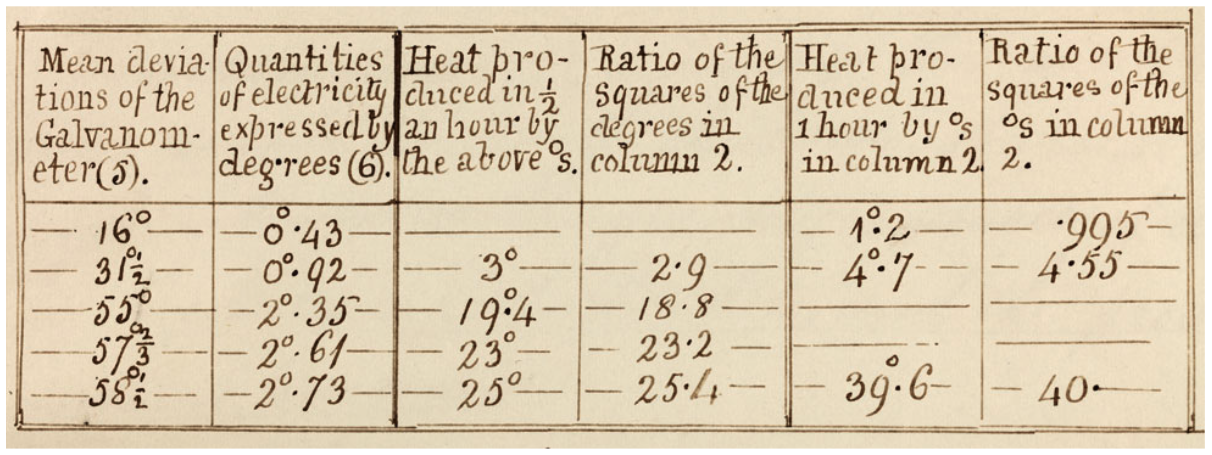
Curiously, Joule had prior experience of working in the brewing business, and his biographers suspect that the accounting skills needed to run such a business and ensure quality control might have shaped his habit of numerical record-keeping in later scientific experiments. Indeed, Joule’s notebooks bear a striking resemblance to brewers’ excise books:
Before putting any water upon his malt for brewing, the brewer is to enter in an excise book or paper, the date of such entry, the quantity of malt intended to be used, and the date of the brewing … 16
That Joule’s notebooks remain mostly silent about the details of measurements suggests he kept them for himself alone. Still, his style wasn’t completely idiosyncratic but indicative of a broader methodological change unfolding in scientific practice at the time.
The nineteenth century saw a tangible improvement in the precision of scientific measurements, and a corresponding shift in judgement where dry numbers came to be trusted more than subjective, narrative descriptions of fallible, all-too-human scientists. Likewise, with the rise of “mechanical objectivity,” photographic images started displacing artistic drawings as illustrations for scientific texts. Some scientists, like the French physiologist and chronophotographer Étienne-Jules Marey, went so far as to declare images to be “the language of the phenomena themselves” and advocated for replacing language with photographs and polygraphs in scientific texts.17
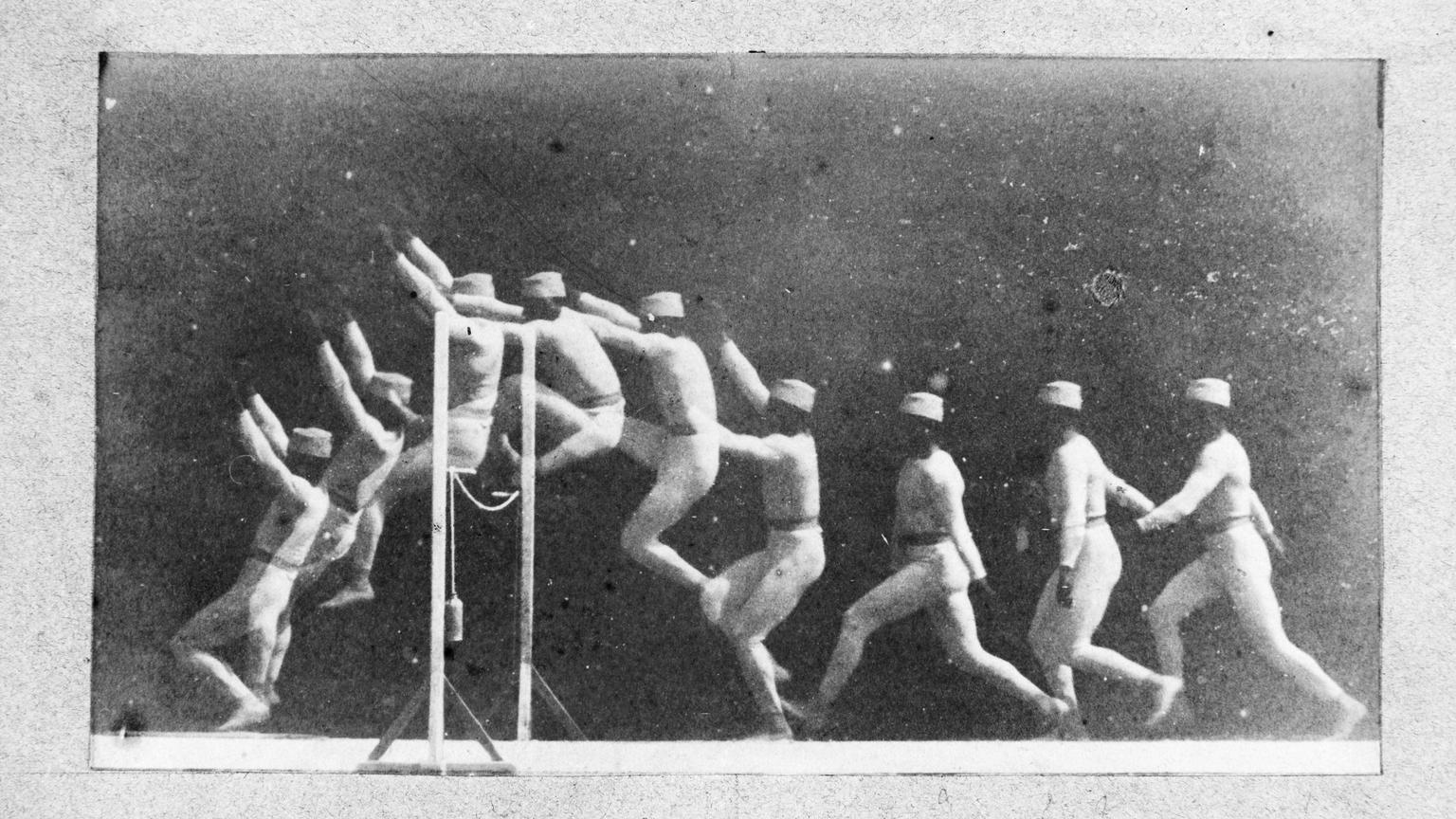
The newly invented instruments like kymographs (tracing spatial position in time) and barographs (tracing atmospheric pressure readings) recorded their own data by generating paper traces as a new type of lab documentation. The lab notebooks increasingly became a place to index and annotate instrument-generated records, along with tabular data and more standardized forms of experiment annotation.
Another shift took place in lab organization, marked by a growth in both lab size and the complexity of coordinated lab operations. The scientific career of the Russian physiologist Ivan Pavlov is an illustration of how lab notetaking practices evolved in response to these changes.18
Pavlov enjoyed a long and prolific life in science. In the 1870s and 80s, he worked in the physiology of digestion and blood circulation, defending his doctoral dissertation on the nerves of the heart in 1883. Next he switched his research focus to digestive physiology, where his work on conditional reflexes (now known as Pavlovian conditioning) in dogs earned him the Nobel Prize in Physiology and Medicine in 1904.
He started his scientific career as a “workshop physiologist,” an independent investigator working in labs at the Veterinary Institute in Saint-Petersburg and later in Breslau (now Wrocław in Poland). During this time, Pavlov designed and conducted his own experiments and analyzed and wrote up his investigations. His lab notebook from this period is a large, thick volume, written in his own hand and reflecting his lab activities: experimental protocols, comments, sketches, and first drafts of research articles.
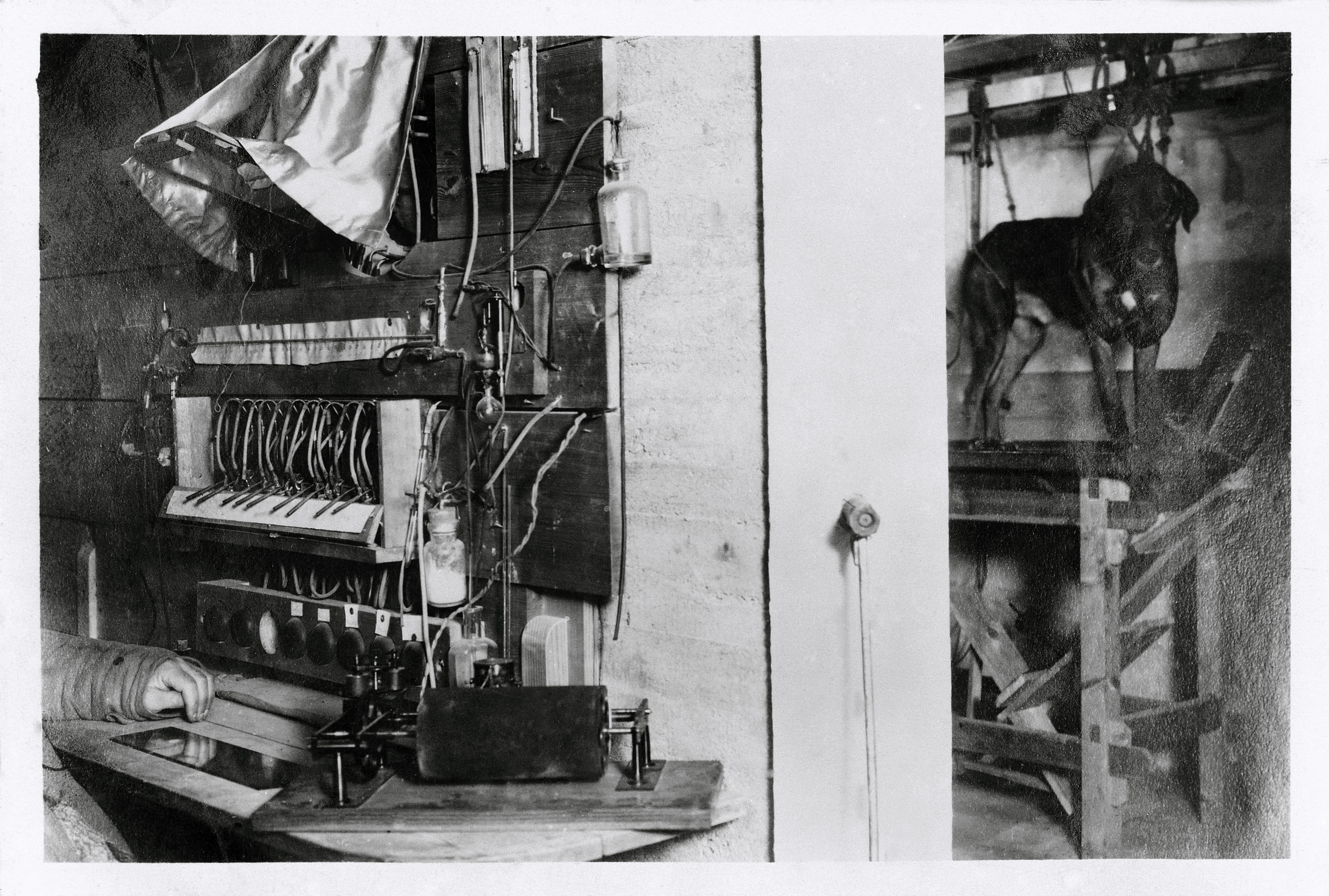
But in 1891, when Pavlov was appointed as the director of the Physiology Division of the newly established Institute of Experimental Medicine in Saint-Petersburg, he became a “factory physiologist” — the head of a large, hierarchically organized lab.19 He was now in charge of many lab assistants and students (“pracititioners”) whom he regarded as his “skilled hands,” almost like extensions of his own body, conducting and keeping records of experiments in pursuit of his own research agenda. Each practitioner was assigned a research question and a subject dog to experiment on.
As lab head, Pavlov introduced stringent notetaking protocols, with each lab notebook following the fate of a particular dog’s surgeries and treatments. The lab notebooks remained in the lab, where Pavlov could always access them. He instructed his practitioners to record procedure descriptions, notes on the dogs’ behavior, and quantitative data. Practitioners were to abstain from adding their own interpretations, leaving that task to Pavlov himself. He would communicate his analysis of experimental data in lab meetings and more casual conversations with colleagues and, eventually, in published articles.

Though Pavlov didn’t maintain his own notebook, entirely relying on his prodigious memory (and the lab notes of his students), in later years he started to delegate some of his thinking to pocket calendar books repurposed as personal notebooks. His archives contain five such notebooks, dating from 1909 to 1918 and from the late 1920s and 30s, when his research interests shifted to higher nervous activity (that is, the activity of the central nervous system). In addition to addresses, reminders, political comments, and philosophical musings, these eclectic notebooks contain notes on research happenings in his lab, ideas for new experiments, and outlines of articles:
“ How will reflexes of time change under the influence of exciter substances: caffeine and so forth?”
“ An interesting episode with Kal’m, that impudent and aggressive dog.”
“ We consider all so-called psychic activity to be a function of the brain mass, of a defined mechanism, that is, of an object conceived spatially. But how can one place in this mechanism an activity that is conceived psychologically, that is, non-spatially [?]”
“ I do not know what exactly we have done, in what way we have broken through, but it is clear to me that there now exists a union of thought, a mixing and unification of the ideas of all participants in the intellectual work [of the laboratory].”
“ Some thoughts and dreams about the current war [World War I]: And the example of Germany and England in this war shows that the idea of a world government is not a true resolution of the land question, but rather a human weakness, originating, so to speak, from the inertia of human nature.”
Pavlov’s was one of the large, almost factory-style laboratories that revolutionized the social and material conditions of scientific research from the late nineteenth century onward. Similar in ambition and scale were those led by the chemist Justus von Liebig, microbiologists Robert Koch and Louis Pasteur, and immunologist Paul Ehrlich. These labs were expensive to maintain, had a purpose-designed workspace, clear division of labor, and an additional layer of lab management, which, among other things, took care of the reliable research record keeping in the lab.
In the twentieth century, scientific institutions continued scaling up, as did the pressure for standardization and reproducibility in science communications, including lab notekeeping.20 With the onset of the digital era, scientific data started moving from physical to digital formats that required large memory storage. Electronic lab notebooks (ELNs) emerged to address these changes, yet their history, in fact, goes back much farther than one might think.
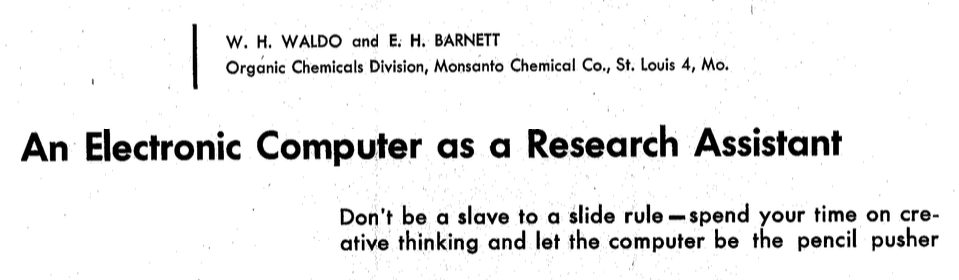
One of the first published records of using computers for lab notekeeping was a 1958 paper titled “ An Electronic Computer as a Research Assistant.”21 It lists several applications for using computers in lab work: mathematical calculations, copying and storage of large volumes of data, and data analysis and interpretation. These were tasks that entailed “computation volume or complexity, which otherwise would have meant thousands of man-hours for calculation.” The article also mentions “routine report preparation” by computers based on paper-based lab records. Lab notebooks thus evolved from paper notebooks to computer-assisted report generation, followed by digitized laboratory databases and, finally, ELNs themselves.
In the 1980s, a chemistry professor at Virginia Polytechnic Institute, Dr. Raymond Dessy, started advocating for the development of ELNs. In 1985, RS/1, a version of an ELN repurposed from a data analysis and statistical software system, was developed by BBN (Bolt, Beranek and Newman, of the ARPANET fame).22 Dessy later created another ELN prototype from scratch in 1994.
Interestingly, ELNs were first enthusiastically welcomed and adopted by the pharmaceutical industry, whereas their acceptance by academic communities took much longer. By 1997, several pharmaceutical and chemical companies supported a new consortium called Collaborative Electronic Notebook Systems Association (CENSA) which worked with scientific software and hardware vendors to assist with the development of ELNs that met the scientific and regulatory needs of the member organizations.
The University of Oregon introduced one of the first web-based ELNs, Virtual Notebook Environment (ViNE), in 1998. By the 2010s, a range of universities started offering institutional ELN subscriptions, but academic adoption as a whole is still patchy. This state of affairs, however, is likely to change in response to the 2024 NIH IRP Electronic Lab Notebook Policy which mandates researchers to “use only electronic resources to document new and ongoing research.”
ELNs facilitate lab record-keeping by enabling version control, timestamping, search function, hierarchical organization of information, the ability to point to external databases and to manipulate diverse data types (numerical, images, and sequences, among others). One may ask, then, why academia has been so reluctant to adopt them.
Besides the general friction towards adopting a new technology, it could be argued that handwriting is more flexible than typing and more conducive to thinking as a result: one can write how and wherever one wants and draw diagrams and sketches alongside it. ELN templates are more rigid and only allow linear text (though it can be richly formatted). The freedom of a blank sheet of paper cannot be surpassed by the already structured space of an empty digital template. Indeed, drawing and writing have historically remained as valuable, and perhaps indispensable, research techniques in their own right.
When pressing for the adoption of ELNs, the emphasis is on standardization, reproducibility, and regulatory compliance — concepts far from lab notebooks’ original use as a space for working through research questions. Perhaps paper notebooks will remain as equivalents of the waste book used by the bookkeepers of yore, while ELNs will serve as ledgers where final, more organized notes on experimental procedures will be recorded.
Ulkar Aghayeva is a science writer and a columnist at Asimov Press. She also writes about science history on her blog Measure for Measure and about music history and cognition on The Bass Line.
Cite: Aghayeva, U. “A Brief History of Lab Notebooks.” Asimov Press(2026). DOI: 10.62211/52wg-76ye
- The Renaissance itself has been described as “fundamentally a notebook culture” (Brian Vickers, Introduction to The Major Works of Francis Bacon (2002)). ↩
- Chapter 8 ,“Collective Note-taking and Robert Hooke’s Dynamic Archive”in Notebooks, English Virtuosi, and Early Modern Science by Richard Yeo (2014), p. 233. ↩
- Notebooks, English Virtuosi, and Early Modern Science by Richard Yeo (2014), p. xii ↩
- Bookkeepers kept a “waste book” as a place for notes recorded on the fly. Later they would extract selected information and copy it into the formal ledger. ↩
- This section is drawing from Chapter 15 The Waste Book in Roland Allen, The Notebook: A History of Thinking on Paper (2023) and Alan E. Shapiro, Newton’s Optical Notebooks: Public Versus Private Data. In: Frederic L. Holmes, Jürgen Renn and Hans-Jörg Rheinberger (eds.) , Reworking the Bench: Research Notebooks in the History of Science, 43–65 © 2003 Kluwer Academic Publishers. ↩
- Unbound notes were typical of seventeenth century natural philosophy investigations and were used by Galileo and Christiaan Huygens, among others. ↩
- Drawing from: William R. Newman and Lawrence M. Principe, The Chymical Laboratory Notebooks of George Starkey. In: Frederic L. Holmes, Jürgen Renn and Hans-Jörg Rheinberger (eds.), Reworking the Bench: Research Notebooks in the History of Science, 25–41 © 2003 Kluwer Academic Publishers. ↩
- Also known as Eirenaeus Philalethes, “a peaceful lover of truth.” ↩
- “Chymystry” is a term referring to both alchemy and chemistry before they were clearly distinguished. ↩
- Drawing from: Friedrich Steinle, The Practice of Studying Practice: Analyzing Research Records of Ampère and Faraday and H. Otto Sibum, Narrating by Numbers: Keeping an Account of Early 19th Century Laboratory Experiences. In: Frederic L. Holmes, Jürgen Renn and Hans-Jörg Rheinberger (eds.), Reworking the Bench: Research Notebooks in the History of Science, pp. 93–118 and 141-158, respectively.© 2003 Kluwer Academic Publishers. ↩
- Faraday is however not the record holder for the longest duration of lab notetaking. That honor seems to belong to Linus Pauling whose lab notebooks span a whopping 72 years, running from 1922 to 1994. Other exceptionally long-running lab notebooks were those of Thomas Edison (spanning 50 years from 1878 and 1928), Alexander Graham Bell (43 years, 1879 to 1922), and Ernst Mach (53 notebooks over 40 years). ↩
- Ryan D. Tweney, Faraday’s notebooks: the active organization of creative science. Phys. Educ. 26 (1991). ↩
- Another example is Joseph Priestley, who once wrote in a letter to a friend, “I have so completely forgotten what I have myself published, that in reading my own writings, what I find in them often appears perfectly new to me, and I have more than once made experiments, the results of which had been published by me.” From Life of Priestley, Centenary Edition, p. 74. ↩
- H. Otto Sibum, Narrating by Numbers: Keeping an Account of Early 19th Century Laboratory Experiences. In: Frederic L. Holmes, Jürgen Renn and Hans-Jörg Rheinberger (eds.), Reworking the Bench: Research Notebooks in the History of Science, p. 142. ↩
- Drawing from: H. Otto Sibum, Narrating by Numbers: Keeping an Account of Early 19th Century Laboratory Experiences. In: Frederic L. Holmes, Jürgen Renn and Hans-Jörg Rheinberger (eds.), Reworking the Bench: Research Notebooks in the History of Science, pp. 141-158. ↩
- Joseph Bateman, The Excise Officer’s Manual: Being a Practical Introduction to the Business of Charging and Collecting the Duties Under the Management of Her Majesties Commissioners of Inland Revenue, second edition (London: William Maxwell, Bell Yard, Lincoln’s Inn — Law and General Publisher, 1852), p. 259. ↩
- Lorraine Daston and Peter Galison, The Image of Objectivity. Representations No. 40, Special Issue: Seeing Science(Autumn, 1992). ↩
- Drawing from: Daniel P. Todes, From Lone Investigator to Laboratory Chief: Ivan Pavlov’s Research Notebooks as a Reflection of His Managerial and Interpretive Style. In: Frederic L. Holmes, Jürgen Renn and Hans-Jörg Rheinberger (eds.), Reworking the Bench: Research Notebooks in the History of Science, 203–220 © 2003 Kluwer Academic Publishers. ↩
- In later years, he also headed additional labs at the Russian Academy of Sciences and the Military-Medical Academy, which he organized similarly. His labs expanded after his 1904 Nobel Prize, as well as in the early 1920s, when he came to terms with the Bolshevik government and received essentially unlimited state funding for his research. ↩
- A classic manual for lab notebook practices is authored by Howard M. Kanare, Writing the Laboratory Notebook (1985). ↩
- W. H. Waldo and E. H. Barnett. An Electronic Computer as a Research Assistant. Industrial & Engineering Chemistry 1958 50 (11), 1641-1643. DOI: 10.1021/ie50587a033. ↩
- Gilbert, William A. RS/1: An Electronic Laboratory Notebook. BioScience 35, no. 9 (1985): 588–90. <http://www.jstor.org/stable/1309968>. There’s also a chapter on “Electronic Notebook” in Howard Kanare’s Writing the Laboratory Notebook (1985). ↩