%20!important%3B%22%2F%3E%0A%3Cpath%20d%3D%22M58.9724%2026.1292C57.6595%2026.1292%2055.9552%2025.7092%2054.1179%2024.896L54.1958%2021.3279H54.591C55.6132%2024.423%2057.4239%2025.3179%2058.9971%2025.3179C60.4411%2025.3179%2061.412%2024.5579%2061.412%2023.2184C61.412%2021.6186%2059.8369%2021.1455%2057.8172%2020.3323C55.4555%2019.3614%2054.04%2018.4437%2054.04%2016.5323C54.04%2014.1972%2055.902%2012.6753%2058.79%2012.6753C60.2717%2012.7131%2061.7288%2013.062%2063.0669%2013.6994L62.9871%2017.0567H62.5672C61.754%2014.1972%2060.1808%2013.4885%2058.7672%2013.4885C57.2187%2013.4885%2056.2231%2014.3017%2056.2231%2015.4569C56.2231%2016.899%2057.8761%2017.2657%2060.2131%2018.2366C62.0238%2018.9453%2063.5989%2019.8116%2063.5989%2022.0935C63.5913%2024.6547%2061.6324%2026.1292%2058.9724%2026.1292Z%22%20fill%3D%22%23123236%22%20style%3D%22fill%3A%20rgb(18%2C%2050%2C%2054)%20!important%3B%22%2F%3E%0A%3Cpath%20d%3D%22M63.8701%2025.5209C65.0234%2025.4164%2065.9601%2025.0744%2065.9601%2023.2637V15.4471C65.9601%2013.6364%2065.0101%2013.2944%2063.8891%2013.1899V12.8289H68.6106V23.2695C68.6106%2025.0801%2069.5606%2025.4221%2070.7101%2025.5266V25.8933H63.8701V25.5209ZM65.1298%209.1809C65.1368%208.71493%2065.3284%208.27077%2065.6625%207.9459C65.9967%207.62104%2066.446%207.44208%2066.912%207.44817C67.3783%207.44157%2067.8282%207.62033%2068.1627%207.94525C68.4973%208.27017%2068.6891%208.7146%2068.6961%209.1809C68.6954%209.41374%2068.6485%209.64416%2068.5583%209.8588C68.468%2010.0734%2068.3362%2010.2681%2068.1703%2010.4315C68.0044%2010.5949%2067.8078%2010.7238%2067.5919%2010.8108C67.3759%2010.8979%2067.1448%2010.9412%2066.912%2010.9384C66.4428%2010.9389%2065.9923%2010.7543%2065.6586%2010.4244C65.3248%2010.0946%2065.1348%209.64629%2065.1298%209.1771V9.1809Z%22%20fill%3D%22%23123236%22%20style%3D%22fill%3A%20rgb(18%2C%2050%2C%2054)%20!important%3B%22%2F%3E%0A%3Cpath%20d%3D%22M85.9783%2025.521C86.9492%2025.4165%2087.7358%2025.0746%2087.7358%2023.2639V17.1516C87.7358%2015.3162%2086.6604%2014.503%2085.3741%2014.503C84.4241%2014.503%2083.5387%2014.9476%2082.6989%2015.8919C82.7255%2016.1807%2082.7521%2016.4961%2082.7521%2016.8115V23.2715C82.7521%2025.0822%2083.5387%2025.4241%2084.5096%2025.5286V25.8954H78.3707V25.5286C79.3416%2025.4241%2080.1282%2025.0822%2080.1282%2023.2715V17.1592C80.1282%2015.3238%2079.0775%2014.5106%2077.7665%2014.5106C76.8165%2014.5106%2075.9824%2014.9552%2075.1426%2015.8995V23.2715C75.1426%2025.0822%2075.9311%2025.4241%2076.9799%2025.5286V25.8954H70.499V25.5286C71.601%2025.4241%2072.494%2025.0822%2072.494%2023.2715V15.4549C72.494%2013.6442%2071.601%2013.3022%2070.499%2013.1977V12.8291H75.1426V15.1908C76.1933%2013.5378%2077.5043%2012.6714%2079.1041%2012.6714C80.7039%2012.6714%2082.0947%2013.5112%2082.5678%2015.3219C83.6698%2013.5891%2085.0378%2012.6714%2086.687%2012.6714C88.6535%2012.6714%2090.3863%2014.0014%2090.3863%2016.8172V23.2772C90.3863%2025.0879%2091.2508%2025.4299%2092.3015%2025.5344V25.901H85.9783V25.521Z%22%20fill%3D%22%23123236%22%20style%3D%22fill%3A%20rgb(18%2C%2050%2C%2054)%20!important%3B%22%2F%3E%0A%3Cpath%20d%3D%22M98.5056%2026.0987C95.1217%2026.0987%2092.209%2023.5014%2092.209%2019.329C92.209%2015.1566%2095.1217%2012.6658%2098.5056%2012.6658C101.889%2012.6658%20104.829%2015.1851%20104.829%2019.329C104.829%2023.4729%20101.889%2026.0987%2098.5056%2026.0987ZM95.1996%2019.329C95.1996%2022.2949%2096.1705%2025.3368%2098.5056%2025.3368C100.841%2025.3368%20101.838%2022.3196%20101.838%2019.329C101.838%2016.3384%20100.814%2013.4276%2098.5056%2013.4276C96.1971%2013.4276%2095.1996%2016.365%2095.1996%2019.329Z%22%20fill%3D%22%23123236%22%20style%3D%22fill%3A%20rgb(18%2C%2050%2C%2054)%20!important%3B%22%2F%3E%0A%3Cpath%20d%3D%22M106.111%2015.2991C105.402%2013.6195%20104.669%2013.3041%20103.855%2013.1996V12.8291H110.315V13.1958C109.162%2013.3269%20108.453%2013.6955%20109.109%2015.2953L112.073%2022.483L114.959%2015.2953C115.616%2013.6423%20114.723%2013.3003%20113.648%2013.1958V12.8291H118.187V13.1958C117.321%2013.3003%20116.508%2013.6423%20115.825%2015.3219L111.602%2025.8878H110.578L106.111%2015.2991Z%22%20fill%3D%22%23123236%22%20style%3D%22fill%3A%20rgb(18%2C%2050%2C%2054)%20!important%3B%22%2F%3E%0A%3Cpath%20d%3D%22M122.474%2025.4944C123.68%2025.3899%20124.678%2025.0232%20124.678%2023.1327V9.7529C124.678%207.8643%20123.68%207.49761%20122.474%207.39311V6.99976H131.261C134.936%206.99976%20137.506%209.49065%20137.506%2012.7434C137.506%2016.3914%20134.466%2018.5689%20130.737%2018.5689H127.588V23.1289C127.588%2025.0289%20128.613%2025.3861%20129.792%2025.4906V25.8839H122.474V25.4944ZM127.588%2017.7291H130.248C132.846%2017.7291%20134.446%2015.4737%20134.446%2012.7434C134.446%2010.0948%20132.977%207.83768%20130.406%207.83768H127.598L127.588%2017.7291Z%22%20fill%3D%22%23123236%22%20style%3D%22fill%3A%20rgb(18%2C%2050%2C%2054)%20!important%3B%22%2F%3E%0A%3Cpath%20d%3D%22M137.533%2025.5207C138.635%2025.4162%20139.553%2025.0743%20139.553%2023.2636V15.4469C139.553%2013.6362%20138.635%2013.2943%20137.533%2013.1898V12.8288H142.23V17.0258C142.832%2014.5084%20144.852%2012.2512%20147.449%2012.7756L147.056%2015.4793H146.866C144.713%2014.5863%20142.589%2016.1613%20142.222%2019.2032V23.2693C142.222%2025.08%20143.14%2025.422%20144.242%2025.5265V25.8931H137.525L137.533%2025.5207Z%22%20fill%3D%22%23123236%22%20style%3D%22fill%3A%20rgb(18%2C%2050%2C%2054)%20!important%3B%22%2F%3E%0A%3Cpath%20d%3D%22M153.488%2026.0987C150.366%2026.0987%20147.533%2023.6591%20147.533%2019.3557C147.533%2015.2631%20149.946%2012.6658%20153.332%2012.6658C156.794%2012.6658%20158.709%2015.3941%20158.682%2018.9623H150.322C150.4%2022.5571%20152.184%2024.4458%20154.493%2024.4458C155.937%2024.4458%20157.326%2023.7636%20158.403%2022.3728L158.717%2022.4508C158.326%2023.5228%20157.614%2024.4484%20156.679%2025.1012C155.743%2025.754%20154.629%2026.1023%20153.488%2026.0987ZM150.34%2018.2023H155.954C155.876%2015.7608%20154.958%2013.4523%20153.252%2013.4523C151.417%2013.4523%20150.473%2015.9451%20150.34%2018.2023Z%22%20fill%3D%22%23123236%22%20style%3D%22fill%3A%20rgb(18%2C%2050%2C%2054)%20!important%3B%22%2F%3E%0A%3Cpath%20d%3D%22M164.817%2026.1292C163.506%2026.1292%20161.8%2025.7092%20159.964%2024.896L160.042%2021.3279H160.432C161.456%2024.423%20163.265%2025.3179%20164.84%2025.3179C166.282%2025.3179%20167.253%2024.5579%20167.253%2023.2184C167.253%2021.6186%20165.68%2021.1455%20163.658%2020.3323C161.298%2019.3614%20159.881%2018.4437%20159.881%2016.5323C159.881%2014.1972%20161.743%2012.6753%20164.631%2012.6753C166.113%2012.7128%20167.57%2013.0618%20168.908%2013.6994L168.83%2017.0567H168.412C167.599%2014.1972%20166.024%2013.4885%20164.612%2013.4885C163.063%2013.4885%20162.066%2014.3017%20162.066%2015.4569C162.066%2016.899%20163.719%2017.2657%20166.056%2018.2366C167.867%2018.9453%20169.44%2019.8116%20169.44%2022.0935C169.434%2024.6547%20167.462%2026.1292%20164.817%2026.1292Z%22%20fill%3D%22%23123236%22%20style%3D%22fill%3A%20rgb(18%2C%2050%2C%2054)%20!important%3B%22%2F%3E%0A%3Cpath%20d%3D%22M175.374%2026.1292C174.061%2026.1292%20172.357%2025.7092%20170.519%2024.896L170.597%2021.3279H170.992C172.015%2024.423%20173.825%2025.3179%20175.398%2025.3179C176.842%2025.3179%20177.813%2024.5579%20177.813%2023.2184C177.813%2021.6186%20176.238%2021.1455%20174.219%2020.3323C171.857%2019.3614%20170.441%2018.4437%20170.441%2016.5323C170.441%2014.1972%20172.303%2012.6753%20175.191%2012.6753C176.673%2012.7131%20178.13%2013.062%20179.468%2013.6994L179.388%2017.0567H178.969C178.155%2014.1972%20176.582%2013.4885%20175.169%2013.4885C173.62%2013.4885%20172.625%2014.3017%20172.625%2015.4569C172.625%2016.899%20174.278%2017.2657%20176.615%2018.2366C178.425%2018.9453%20180%2019.8116%20180%2022.0935C179.991%2024.6547%20178.022%2026.1292%20175.374%2026.1292Z%22%20fill%3D%22%23123236%22%20style%3D%22fill%3A%20rgb(18%2C%2050%2C%2054)%20!important%3B%22%2F%3E%0A%3Cpath%20d%3D%22M22.4922%2011.2518C22.4892%208.37895%2021.3888%205.61569%2019.4159%203.52733C17.4431%201.43898%2014.7468%200.183268%2011.8788%200.0170703V0H10.6134V0.0170703C7.74531%200.183268%205.04911%201.43898%203.07625%203.52733C1.10338%205.61569%200.00294138%208.37895%200%2011.2518V33.1189H0.632691C2.96479%2033.1153%205.2383%2032.388%207.13939%2031.0372C9.04048%2029.6864%2010.4754%2027.7789%2011.2461%2025.5778C12.018%2027.7776%2013.4533%2029.6838%2015.3543%2031.0335C17.2553%2032.3832%2019.5281%2033.1097%2021.8595%2033.1131H22.4922V11.2518ZM21.2268%2011.2518C21.2224%2013.7878%2020.2544%2016.2273%2018.5187%2018.0762C16.783%2019.9252%2014.4094%2021.0453%2011.8788%2021.2096V1.27869C14.4122%201.44322%2016.7882%202.56537%2018.5246%204.41749C20.261%206.26962%2021.2277%208.71304%2021.2287%2011.2518H21.2268ZM1.26731%2031.8287V11.2518C1.26878%208.71426%202.23567%206.27223%203.97174%204.42148C5.70781%202.57073%208.083%201.44987%2010.6153%201.2863V21.8746C10.6096%2024.4098%209.64093%2026.8482%207.90542%2028.6963C6.16991%2030.5443%203.79715%2031.664%201.26731%2031.8287ZM21.2287%2031.8287C18.8025%2031.6704%2016.5171%2030.6333%2014.8004%2028.9116C13.0836%2027.1899%2012.0531%2024.9017%2011.9016%2022.4751C13.8477%2022.3595%2015.7303%2021.7405%2017.3653%2020.6787C19.0003%2019.6169%2020.3315%2018.1487%2021.2287%2016.4179V31.8287Z%22%20fill%3D%22%23123236%22%20style%3D%22fill%3A%20rgb(18%2C%2050%2C%2054)%20!important%3B%22%2F%3E%0A%3C%2Fsvg%3E)

In the 1960s, David Chambers, a researcher at Deakin University in Australia, instructed teachers to give children a blank sheet of paper and ask them to draw a scientist. Chambers repeated this experiment many times over eleven years, collecting more than 4,800 drawings. The results were surprisingly consistent: white lab coat, glasses, beakers, mysterious machinery, someone saying “eureka!” The study has since been repeated dozens of times. While some details have changed, with beakers replaced by rockets, microscopes by vaccines, or men by women (sometimes), the scientist always wears a white lab coat.
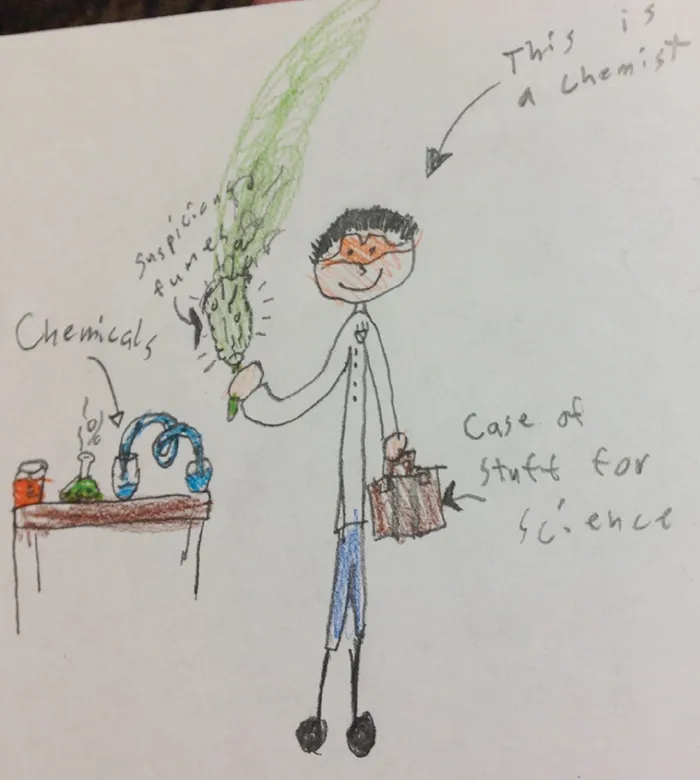
The white lab coat, however, only came to symbolize scientists in the 20th century. Before that, cartoonists satirized chemists by portraying their craft as sorcery whose practitioners wore long dark robes, and painters drew naturalists in waistcoats and breeches against backdrops of plants and landscapes. It was really surgery, more than any other scientific discipline, that gave us the white laboratory coat. Today, scientists don a variety of multicolored, specialized protective equipment to suit the needs of their field, but the fact that children still inextricably link white lab coats to “scientists” says everything about how a simple garment came to exemplify a profession’s public image.
To understand how the white lab coat arose, we have to go back to Victorian England to examine not the scientists, but rather the fashion of that time.
In mid-19th-century England, so-called “gentlemen of science” dressed in dark frock coats. In his 1885 portrait, Louis Pasteur stood in his laboratory, rabies sample in hand, in a black frock coat, waistcoat, and black cravat. Charles Darwin, whose personal home was his “laboratory,” sported a similar style. John Snow, the epidemiologist best known for tracing the source of London’s cholera epidemic, inspected the Broad Street pump while dressed like a banker, in a multipiece suit and tie.
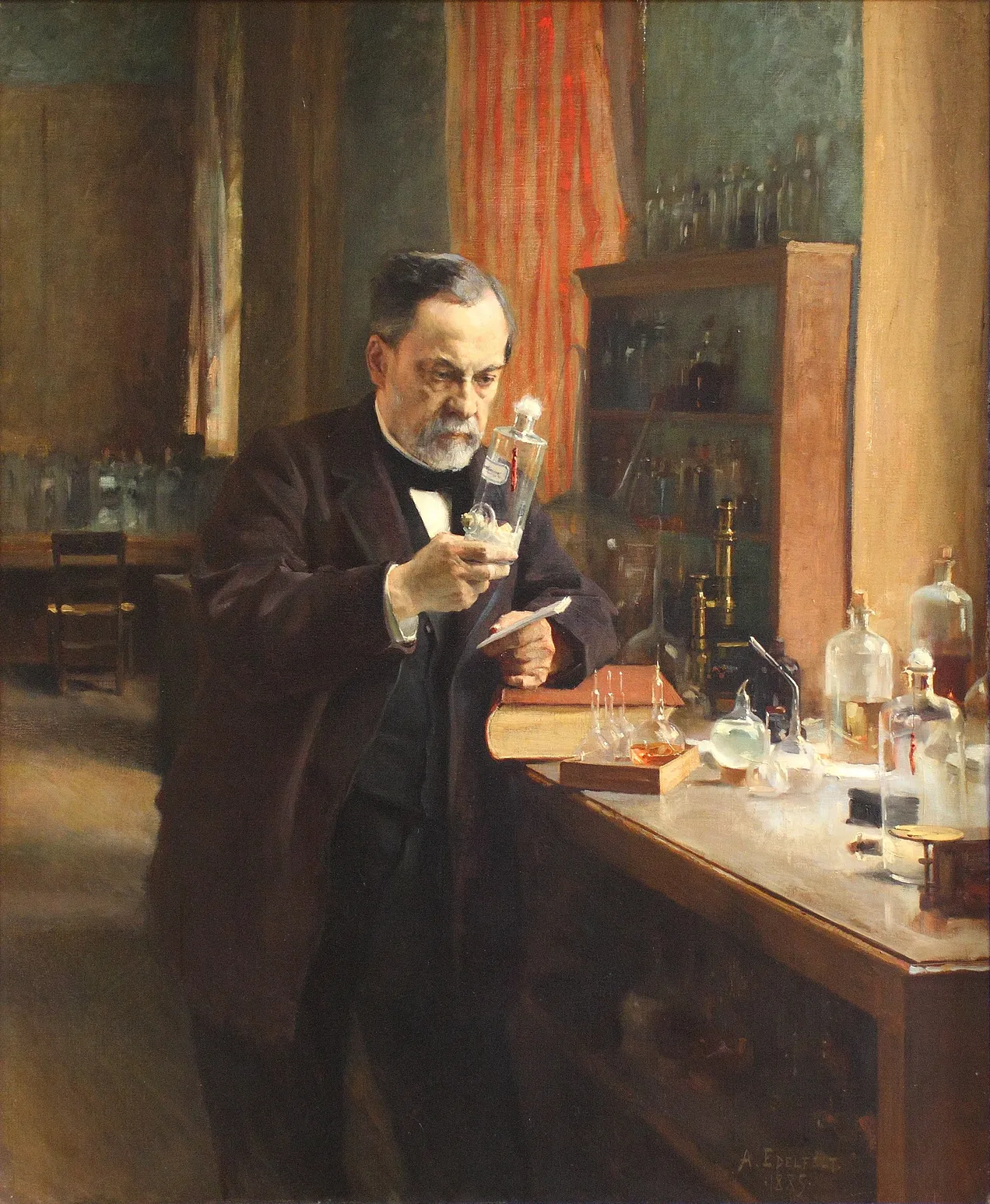
This style was influenced by Prince Albert, Queen Victoria’s consort, who elevated the frock coat into a fitted, double-breasted symbol of class in the 1850s. Though the Prince himself likely never fooled around with specimens and staining chemicals, the darkness of the coats he popularized benefited scientists, who didn’t want the stains of their labors visible. Frock coats were, after all, very tedious to wash in the days before laundry machines.
However, for blood-splattered Victorian surgeons, the situation was much worse; heavy and woolen, the frock coat absorbed just about any fluid. Stories of surgeons making their rounds in bloody black robes reeking of rot and sweat are most likely accurate. The esteemed surgeon Sir Frederick Treves (credited with saving the life of King Edward VII in 1902) reminisced in his 1923 book: “The surgeon operated in a slaughter-house-suggesting frock coat of black cloth. It was stiff with the blood and the filth of years. The more sodden it was, the more forcibly did it bear evidence to the surgeon’s prowess.”
Beyond being filthy, frock coats were also very uncomfortable. The sawing, stitching, and other manipulations of surgery were already messy, laborious work, but operating rooms grew even more “clammy and sodden” after Joseph Lister introduced his carbolic spray antiseptic. Lister himself stripped off his frock and “turned up his shirt sleeves” and “pinned an ordinary unsterilized huckaback towel over his waistcoat (for his own protection, not that of the patient).”
In fact, Lister never advocated for changing the fabric of surgical garments. His writings from 1867 assured his readers that using carbolic spray was enough to keep infection risks low. In any case, illustrations from the bacteriologist Watson Cheyne’s authoritative 1882 textbook on antiseptic surgery showed a group of surgeons working in full formal attire, with their outdoor coats and hats resting on a nearby windowsill.
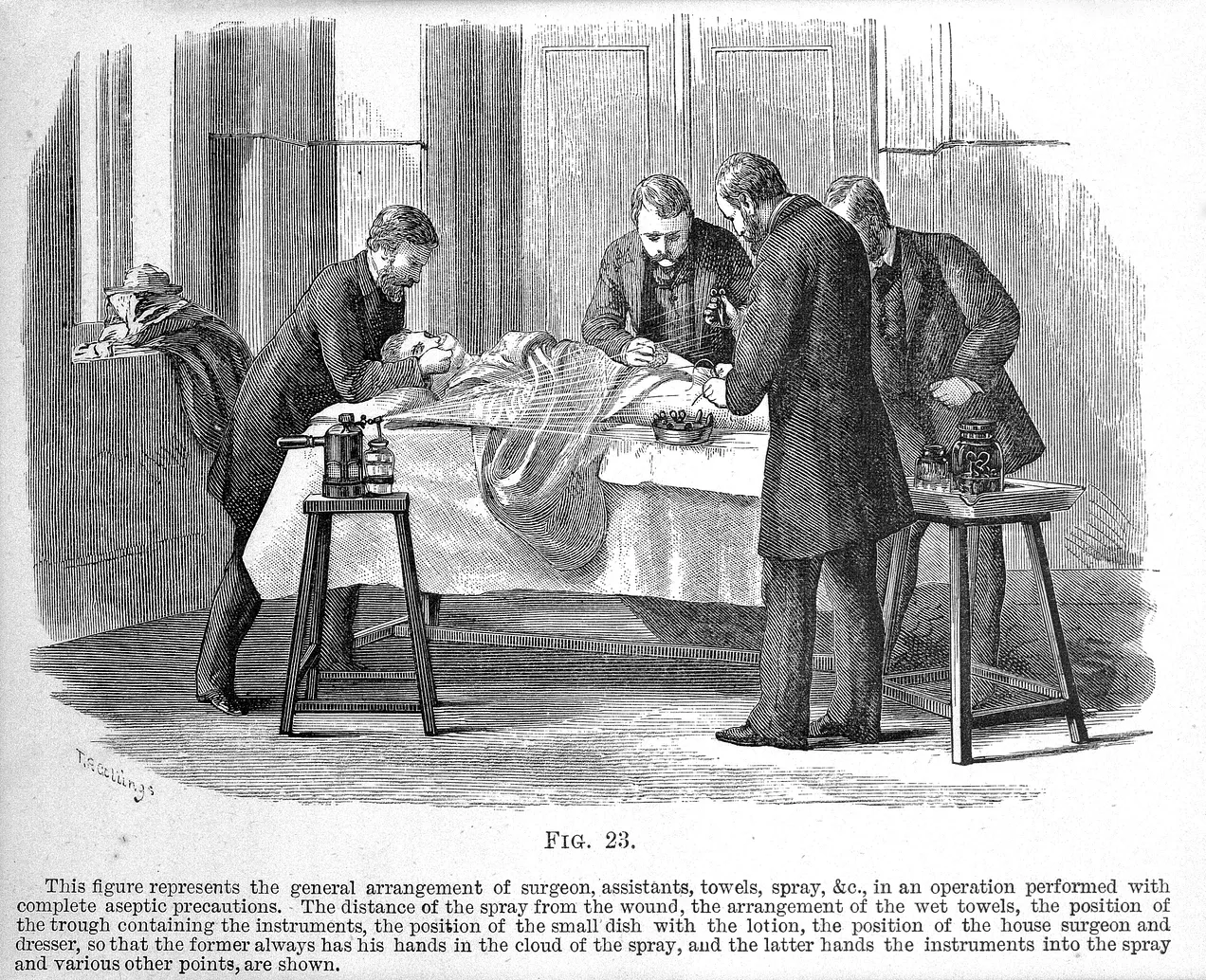
These early practitioners of science suffered from the expectation that they would, at all times, appear genteel. Even while hard at work, they eschewed light fabrics, protective gear, and aprons in favor of a wardrobe that demarcated their prestige.
The real driver of white lab coats was the hygienist movement. The mid-19th century witnessed dramatic strides in public sanitation. Rivers of free-flowing feces and effluent gave way to managed sewage disposal systems. Public bathhouses opened, such as the 1842 warm fresh-water baths on Frederick Street in Liverpool, England, serving the “vast numbers of workmen” of the 500,000 that populated the borough. The introduction of hand-washing in obstetrics in 1847 began to save patients, with doctors in other fields following suit. Motorized washing machines were invented in 1851. The domestic use of soap in England nearly tripled between 1801 and 1861, and then almost doubled again by 1891, and suddenly, both being and looking clean became possible.
Ice cream vendors, butchers, and bakers were also adopting white clothing as their professional uniforms to project the image of working under sanitary conditions. White made any breach of cleanliness immediately obvious, another way to reassure their newly cleanliness-obsessed customers of the shops’ safety and security.
By the 1880s, some surgeons were beginning to adopt this aesthetic of cleanliness in their practices, like Robert Lawson Tait, a gynecological surgeon who donned a white apron. Tait used soap and water on patient skin, boiled instruments, applied freshly “laundried” towels around wounds, and had a regimented hand-washing ritual before operating. His surgical attire was a visual signal meant to attract paying clientele.
Other surgeons took this fashion further. When Australian surgeon Alexander MacCormick became “the first man in Sydney to wear a white coat while operating” in the 1880s, his colleagues mocked him: “MacCormick was called the ‘Hokey Pokey Man,’ a reference to the popular confection called hokey-pokey, sold by ice cream vendors,” write historians Susan Hardy and Anthony Corones in Dressed to Heal: The Changing Semiotics of Surgical Dress. The joke backfired. Patients flocked to him, attracted by his gleaming cleanliness.
The white medical garment popularized during this period was everything the frock coat wasn’t: washable, lightweight, cheap, and disposable. Hospitals could send uniforms to commercial laundries with a quick turnaround. Textile mills churned out mass-produced cotton and linen garments after the Civil War. By contrast, frock coats were still tailor-made from broadcloth, which took tremendous time and effort.
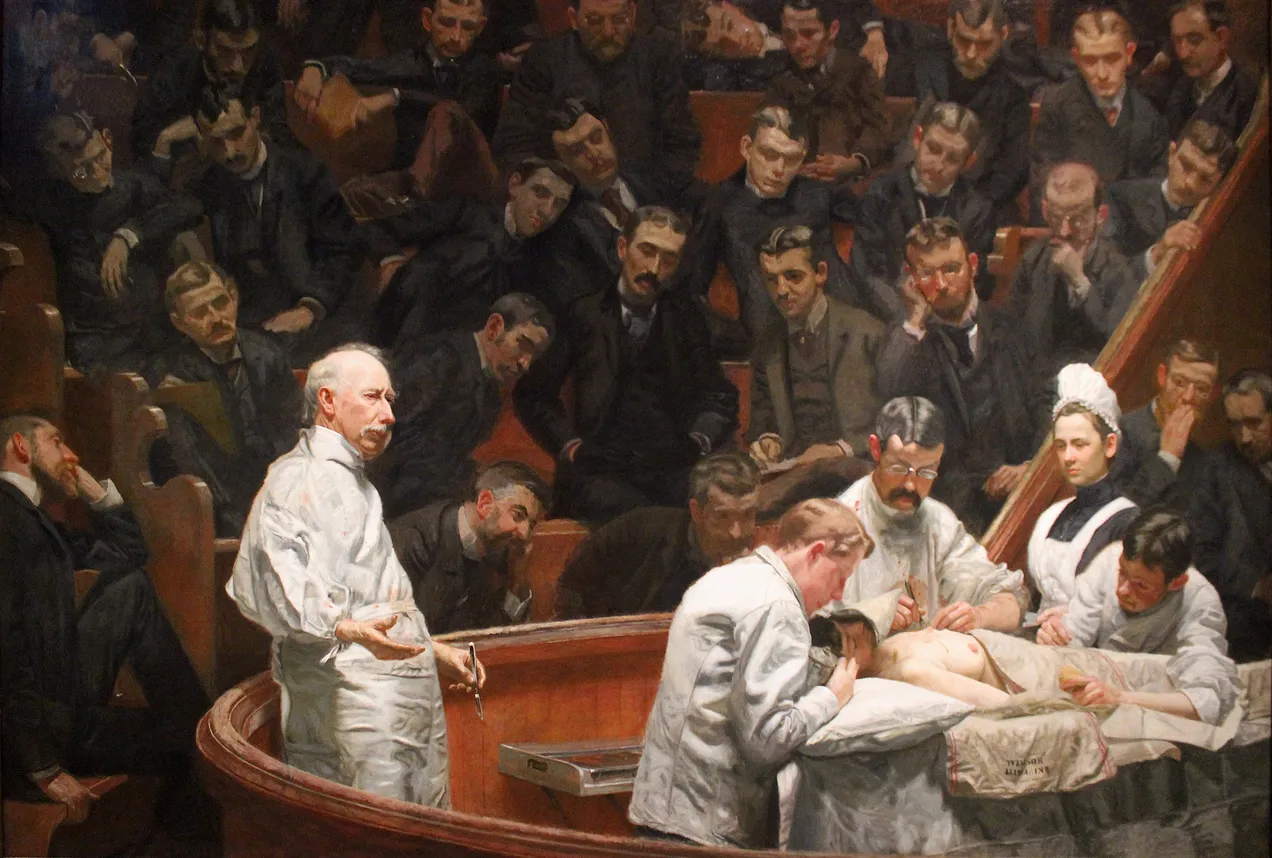
Two famous portraits from the American painter Thomas Eakins capture the transition from black to white. “The Gross Clinic” from 1875 shows surgeon Samuel Gross and his assistants in black coats, blood on their hands, with a skylight letting in the noontime sun. The patient is a young man wearing his street socks. When this life-size painting was introduced at the 1876 United States Centennial Exposition in Philadelphia, it was relegated to a remote corner of the exhibit hall after having been initially rejected for display at all. Some scholars suspect that the painting was too “realistic” for a public that now expected visible hygiene.
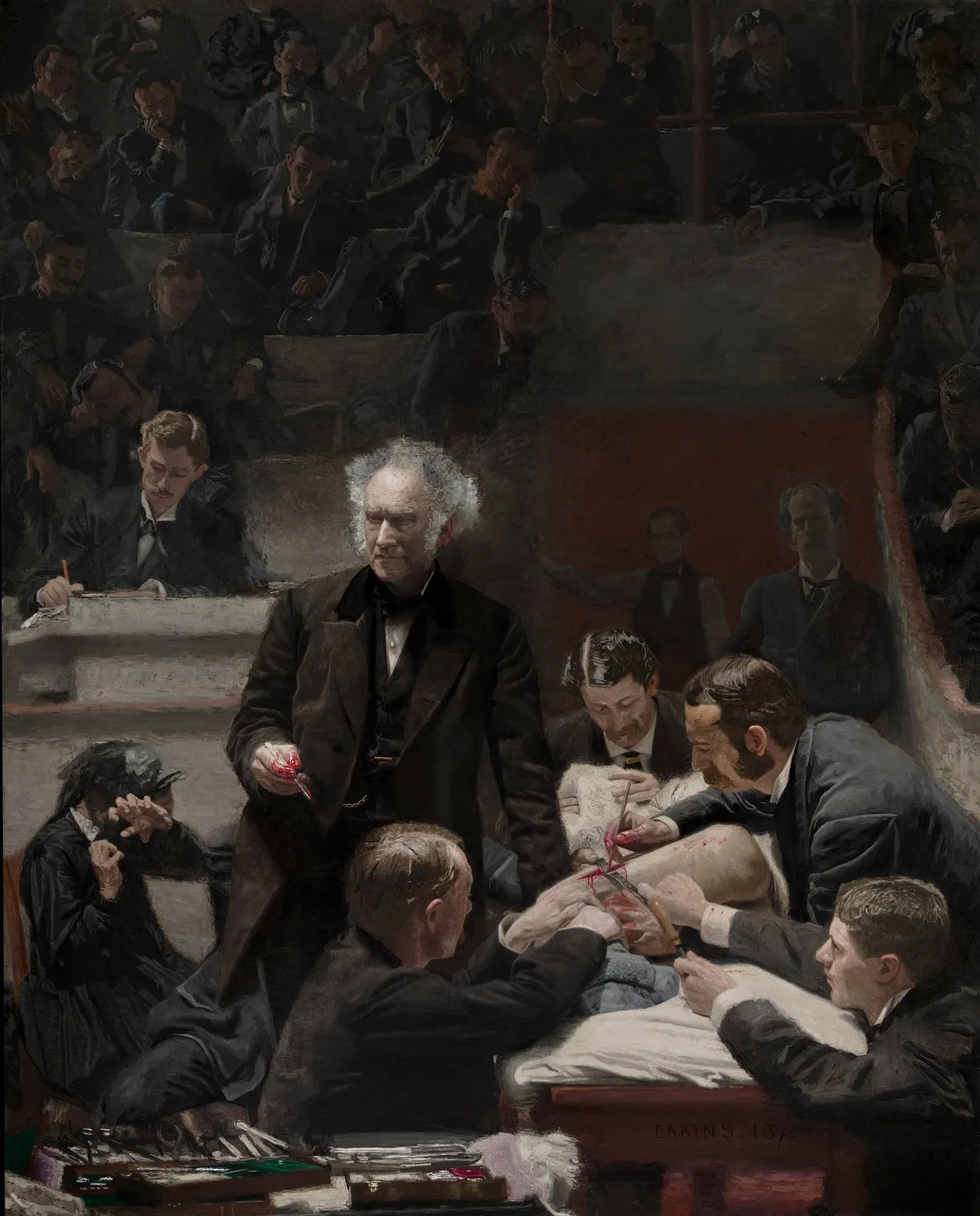
“The Agnew Clinic,” painted in 1889, presents a stark contrast, with surgeon David Hayes Agnew and colleagues in shining white gowns using sterilized instruments under artificial light. The patient is draped in white sheets on a white table. Here, however, the painting is misleading because Agnew was remarkably resistant to adopting these practices. The public remembered Agnew as one of the several attending physicians to the beloved President James A. Garfield after he was shot in the back at a railroad station in DC in 1881. Agnew had poked and prodded at the President’s bullet wound without ever having washed his hands or sterilizing his probes. As the President developed abscesses, Dr. Agnew would drain them with dirty instruments.
The younger generations of American surgeons watched in horror, but even after this high-profile disaster (with evidence of the infected abscesses revealed when the president succumbed to his injury two months later), Agnew didn’t change his techniques. Just a year before this painting was made, a photograph shows Agnew in a clinic, wearing a nice, buttoned-up street coat just as Samuel Gross had a decade before.
The new expectations of operating rooms didn’t immediately apply to those of the laboratory. White linens weren’t as practical for bench science as they were for clinical medicine. Industrial chemists, for example, were known to wear brownish — not white — coats and aprons, often made of leather, in German and British labs in the early 1900s. Wanting to hide the stains of her experimentation, famed physicist and chemist Marie Curie requested her wedding dress to be “practical and dark” so that she could afterwards wear it in the lab. This she did, until switching to black dresses upon the death of her husband in 1906.
Curie was not alone in preferring black for cleanliness. French surgeon and biologist Alexis Carrel worked out of a black-walled lab and wore black deliberately because it showed dust. Black also works better for contrast when using white mice and powders, as well as hiding any blood or pigment stains. Even today, some scientists prefer black labwear.
Despite such outliers, white lab coats have become synonymous with lab scientists, even if experts disagree on exactly when the white lab coat made its way into the lab. A 1902 photograph in a neurobiological lab in Berlin, for example, shows researchers wearing long, light colored coats while working at benches. Another from 1922 shows two industrial chemists wearing what appear to be white coats.
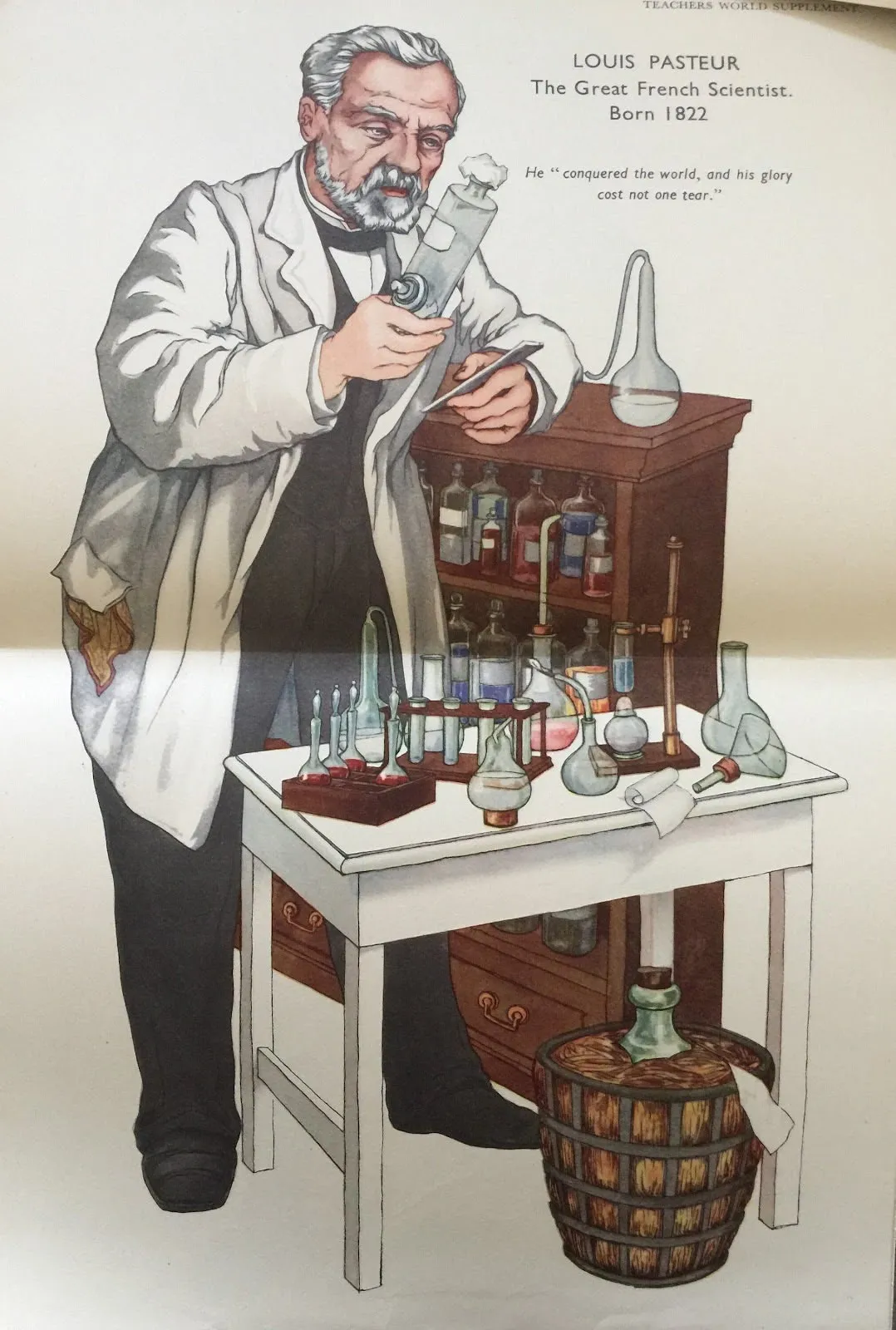
Of course, the coats in these black-and-white photographs could actually be light brown, or they could have been touched up in retrospect, with photo-editors assuming the coats were white. After all, many paintings and reproductions show scientists wearing white lab coats long before they would’ve actually worn them. For example, a 1930s lithograph from the “Teachers World” supplement shows an illustration of Pasteur mulling over test tubes in a white lab coat.
The standard garb of laboratory workers also began to shift to white during the turn of the 20th century, when the relationship between medicine and laboratory science became more entwined. Lab scientists likely adopted surgical fashion as a result. In 1898, Sir William Osler, a Canadian physician already known for writing some of the first clinical laboratory literature, introduced ward laboratories at Johns Hopkins Hospital. Gradually, surgical practice relied on laboratories for tools, microscopes, chemical assays, pathology reports, and bacterial cultures to diagnose patients.
After the American education reformer, Abraham Flexner, visited medical schools all over America, he published a report in 1910 calling for restructuring medical education by getting rid of private medical schools, standardizing admissions, laboratory access, and curricula. With this, hospitals transformed from small, charitable institutions for the urban poor to large, funded medical centers serving mixed-class populations. They projected an image of themselves as safe, clean places, with the white lab coat — worn by surgeons and lab scientists alike — as evidence of that promise.
This white coat also became a way for these professionals to signal their membership in their respective highly-trained “guilds,” separating themselves from non-scientists. When chemistry historian Peter Morris stumbled upon a 1950s photograph of schoolboys from his alma mater wearing white lab coats, he theorized that the coat was introduced “to inculcate an ‘esprit de corps’ in students and laboratory workers” to improve morale rather than protect clothing.
Social psychologists tested a similar theory in 2012. Students wearing white coats, which they believed were doctors’ coats, performed better on tests. Students wearing identical coats, which they thought were painters’ smocks, showed no improvement. While the researchers called this observed phenomenon “enclothed cognition,” the real takeaway was perhaps much more intuitive — clothing shapes the way we think about ourselves.
The powerful symbolism explains the lab coat’s persistence even as we question its functionality. In 2009, a UCLA researcher was transferring tert-butyl lithium, a chemical that ignites spontaneously in air, between tubes. She wore safety glasses and nitrile gloves but no lab coat. When the syringe malfunctioned, and the highly flammable chemical splashed on her synthetic sweater, the synthetic material, essentially a solid form of gasoline, caught fire immediately. A colleague tried to smother the flames with his own lab coat, but failed. She should have been rushed to the emergency shower, but in the panic, she was not. She died from her burns, which covered 40 percent of her body.
Could a lab coat have saved her? Some are skeptical, since many common lab coats are also made of flammable, synthetic materials. But a flame-resistant coat, which had been commercially available for years, certainly might have.
Indeed, the incident incited a widespread rethinking of PPE, which is often eschewed for being bulky and cumbersome. Unfortunately, the environment the UCLA researcher worked in and the “circumstances that led to her death were certainly not unique.” Laboratory safety standards often lag behind available technology, and a culture of safety and training is wanting, even today.
Despite such lassitude, the lab coat has become an object of innovation. In 2012, MIT launched an initiative to create lab coats that scientists actually wanted to wear, addressing not just design but laundry logistics and institutional culture. The MIT Media Lab took this a step further, declaring, “Media Lab researchers are not only scientists — we are also designers, tinkerers, philosophers and artists. We need a different coat!” Their philosophy is that PPE should not only protect scientists but also support the exact kind of work they do. A scientist carrying around motors needs specialized pockets; one that works with lasers needs a reflective coating.
Since then, material science has ushered in promising possibilities for industrial uniforms, including lab coats, though many of these breakthroughs are in the research phase as of 2025. Scientists are experimenting with sustainable, bioactive coatings like chitosan (from seashells) and silver nanoparticles — natural microbial fighters — as well as phosphorus-based flame retardants that are highly effective at low concentrations. Built layer-by-layer with nanoparticles such as silica and titanium oxide, the experimental textiles can self-clean when activated by short periods in the sun. While we have yet to scale these innovations, their potential to improve lab coat functionality and clothing in general is worth watching.
Today, despite a wider array of shapes, colors, sizes, and materials, the archetypal dress of the laboratory remains the white coat. This suggests that the broader challenge is not design, but adoption. How do scientific institutions create new symbols of identity that prioritize function over tradition? Looking at the history of the white coat, we can observe that the shift from black frocks to white coats took decades and required not only technological but cultural change. The next transition, from symbolic to specialized PPE and laboratory wear, requires a similar shift in imagination.
Donna Vatnick writes essays that explore scientific discovery and its most passionate devotees. Before completing her MFA in nonfiction, she worked in molecular biology labs and coordinated clinical trials in Boston.
Acknowledgements: Thanks to Kate Goldkamp and Natasha Muhametzyanova for their research guidance, and Ethan Madore and Julia Zaltsman for valuable conversations. Header credit: Wellcome Collection.
Cite: Vatnick, D. “Why Lab Coats Are White.” Asimov Press (2026). DOI: 10.62211/62hw-98tk