%20!important%3B%22%2F%3E%0A%3Cpath%20d%3D%22M58.9724%2026.1292C57.6595%2026.1292%2055.9552%2025.7092%2054.1179%2024.896L54.1958%2021.3279H54.591C55.6132%2024.423%2057.4239%2025.3179%2058.9971%2025.3179C60.4411%2025.3179%2061.412%2024.5579%2061.412%2023.2184C61.412%2021.6186%2059.8369%2021.1455%2057.8172%2020.3323C55.4555%2019.3614%2054.04%2018.4437%2054.04%2016.5323C54.04%2014.1972%2055.902%2012.6753%2058.79%2012.6753C60.2717%2012.7131%2061.7288%2013.062%2063.0669%2013.6994L62.9871%2017.0567H62.5672C61.754%2014.1972%2060.1808%2013.4885%2058.7672%2013.4885C57.2187%2013.4885%2056.2231%2014.3017%2056.2231%2015.4569C56.2231%2016.899%2057.8761%2017.2657%2060.2131%2018.2366C62.0238%2018.9453%2063.5989%2019.8116%2063.5989%2022.0935C63.5913%2024.6547%2061.6324%2026.1292%2058.9724%2026.1292Z%22%20fill%3D%22%23123236%22%20style%3D%22fill%3A%20rgb(18%2C%2050%2C%2054)%20!important%3B%22%2F%3E%0A%3Cpath%20d%3D%22M63.8701%2025.5209C65.0234%2025.4164%2065.9601%2025.0744%2065.9601%2023.2637V15.4471C65.9601%2013.6364%2065.0101%2013.2944%2063.8891%2013.1899V12.8289H68.6106V23.2695C68.6106%2025.0801%2069.5606%2025.4221%2070.7101%2025.5266V25.8933H63.8701V25.5209ZM65.1298%209.1809C65.1368%208.71493%2065.3284%208.27077%2065.6625%207.9459C65.9967%207.62104%2066.446%207.44208%2066.912%207.44817C67.3783%207.44157%2067.8282%207.62033%2068.1627%207.94525C68.4973%208.27017%2068.6891%208.7146%2068.6961%209.1809C68.6954%209.41374%2068.6485%209.64416%2068.5583%209.8588C68.468%2010.0734%2068.3362%2010.2681%2068.1703%2010.4315C68.0044%2010.5949%2067.8078%2010.7238%2067.5919%2010.8108C67.3759%2010.8979%2067.1448%2010.9412%2066.912%2010.9384C66.4428%2010.9389%2065.9923%2010.7543%2065.6586%2010.4244C65.3248%2010.0946%2065.1348%209.64629%2065.1298%209.1771V9.1809Z%22%20fill%3D%22%23123236%22%20style%3D%22fill%3A%20rgb(18%2C%2050%2C%2054)%20!important%3B%22%2F%3E%0A%3Cpath%20d%3D%22M85.9783%2025.521C86.9492%2025.4165%2087.7358%2025.0746%2087.7358%2023.2639V17.1516C87.7358%2015.3162%2086.6604%2014.503%2085.3741%2014.503C84.4241%2014.503%2083.5387%2014.9476%2082.6989%2015.8919C82.7255%2016.1807%2082.7521%2016.4961%2082.7521%2016.8115V23.2715C82.7521%2025.0822%2083.5387%2025.4241%2084.5096%2025.5286V25.8954H78.3707V25.5286C79.3416%2025.4241%2080.1282%2025.0822%2080.1282%2023.2715V17.1592C80.1282%2015.3238%2079.0775%2014.5106%2077.7665%2014.5106C76.8165%2014.5106%2075.9824%2014.9552%2075.1426%2015.8995V23.2715C75.1426%2025.0822%2075.9311%2025.4241%2076.9799%2025.5286V25.8954H70.499V25.5286C71.601%2025.4241%2072.494%2025.0822%2072.494%2023.2715V15.4549C72.494%2013.6442%2071.601%2013.3022%2070.499%2013.1977V12.8291H75.1426V15.1908C76.1933%2013.5378%2077.5043%2012.6714%2079.1041%2012.6714C80.7039%2012.6714%2082.0947%2013.5112%2082.5678%2015.3219C83.6698%2013.5891%2085.0378%2012.6714%2086.687%2012.6714C88.6535%2012.6714%2090.3863%2014.0014%2090.3863%2016.8172V23.2772C90.3863%2025.0879%2091.2508%2025.4299%2092.3015%2025.5344V25.901H85.9783V25.521Z%22%20fill%3D%22%23123236%22%20style%3D%22fill%3A%20rgb(18%2C%2050%2C%2054)%20!important%3B%22%2F%3E%0A%3Cpath%20d%3D%22M98.5056%2026.0987C95.1217%2026.0987%2092.209%2023.5014%2092.209%2019.329C92.209%2015.1566%2095.1217%2012.6658%2098.5056%2012.6658C101.889%2012.6658%20104.829%2015.1851%20104.829%2019.329C104.829%2023.4729%20101.889%2026.0987%2098.5056%2026.0987ZM95.1996%2019.329C95.1996%2022.2949%2096.1705%2025.3368%2098.5056%2025.3368C100.841%2025.3368%20101.838%2022.3196%20101.838%2019.329C101.838%2016.3384%20100.814%2013.4276%2098.5056%2013.4276C96.1971%2013.4276%2095.1996%2016.365%2095.1996%2019.329Z%22%20fill%3D%22%23123236%22%20style%3D%22fill%3A%20rgb(18%2C%2050%2C%2054)%20!important%3B%22%2F%3E%0A%3Cpath%20d%3D%22M106.111%2015.2991C105.402%2013.6195%20104.669%2013.3041%20103.855%2013.1996V12.8291H110.315V13.1958C109.162%2013.3269%20108.453%2013.6955%20109.109%2015.2953L112.073%2022.483L114.959%2015.2953C115.616%2013.6423%20114.723%2013.3003%20113.648%2013.1958V12.8291H118.187V13.1958C117.321%2013.3003%20116.508%2013.6423%20115.825%2015.3219L111.602%2025.8878H110.578L106.111%2015.2991Z%22%20fill%3D%22%23123236%22%20style%3D%22fill%3A%20rgb(18%2C%2050%2C%2054)%20!important%3B%22%2F%3E%0A%3Cpath%20d%3D%22M122.474%2025.4944C123.68%2025.3899%20124.678%2025.0232%20124.678%2023.1327V9.7529C124.678%207.8643%20123.68%207.49761%20122.474%207.39311V6.99976H131.261C134.936%206.99976%20137.506%209.49065%20137.506%2012.7434C137.506%2016.3914%20134.466%2018.5689%20130.737%2018.5689H127.588V23.1289C127.588%2025.0289%20128.613%2025.3861%20129.792%2025.4906V25.8839H122.474V25.4944ZM127.588%2017.7291H130.248C132.846%2017.7291%20134.446%2015.4737%20134.446%2012.7434C134.446%2010.0948%20132.977%207.83768%20130.406%207.83768H127.598L127.588%2017.7291Z%22%20fill%3D%22%23123236%22%20style%3D%22fill%3A%20rgb(18%2C%2050%2C%2054)%20!important%3B%22%2F%3E%0A%3Cpath%20d%3D%22M137.533%2025.5207C138.635%2025.4162%20139.553%2025.0743%20139.553%2023.2636V15.4469C139.553%2013.6362%20138.635%2013.2943%20137.533%2013.1898V12.8288H142.23V17.0258C142.832%2014.5084%20144.852%2012.2512%20147.449%2012.7756L147.056%2015.4793H146.866C144.713%2014.5863%20142.589%2016.1613%20142.222%2019.2032V23.2693C142.222%2025.08%20143.14%2025.422%20144.242%2025.5265V25.8931H137.525L137.533%2025.5207Z%22%20fill%3D%22%23123236%22%20style%3D%22fill%3A%20rgb(18%2C%2050%2C%2054)%20!important%3B%22%2F%3E%0A%3Cpath%20d%3D%22M153.488%2026.0987C150.366%2026.0987%20147.533%2023.6591%20147.533%2019.3557C147.533%2015.2631%20149.946%2012.6658%20153.332%2012.6658C156.794%2012.6658%20158.709%2015.3941%20158.682%2018.9623H150.322C150.4%2022.5571%20152.184%2024.4458%20154.493%2024.4458C155.937%2024.4458%20157.326%2023.7636%20158.403%2022.3728L158.717%2022.4508C158.326%2023.5228%20157.614%2024.4484%20156.679%2025.1012C155.743%2025.754%20154.629%2026.1023%20153.488%2026.0987ZM150.34%2018.2023H155.954C155.876%2015.7608%20154.958%2013.4523%20153.252%2013.4523C151.417%2013.4523%20150.473%2015.9451%20150.34%2018.2023Z%22%20fill%3D%22%23123236%22%20style%3D%22fill%3A%20rgb(18%2C%2050%2C%2054)%20!important%3B%22%2F%3E%0A%3Cpath%20d%3D%22M164.817%2026.1292C163.506%2026.1292%20161.8%2025.7092%20159.964%2024.896L160.042%2021.3279H160.432C161.456%2024.423%20163.265%2025.3179%20164.84%2025.3179C166.282%2025.3179%20167.253%2024.5579%20167.253%2023.2184C167.253%2021.6186%20165.68%2021.1455%20163.658%2020.3323C161.298%2019.3614%20159.881%2018.4437%20159.881%2016.5323C159.881%2014.1972%20161.743%2012.6753%20164.631%2012.6753C166.113%2012.7128%20167.57%2013.0618%20168.908%2013.6994L168.83%2017.0567H168.412C167.599%2014.1972%20166.024%2013.4885%20164.612%2013.4885C163.063%2013.4885%20162.066%2014.3017%20162.066%2015.4569C162.066%2016.899%20163.719%2017.2657%20166.056%2018.2366C167.867%2018.9453%20169.44%2019.8116%20169.44%2022.0935C169.434%2024.6547%20167.462%2026.1292%20164.817%2026.1292Z%22%20fill%3D%22%23123236%22%20style%3D%22fill%3A%20rgb(18%2C%2050%2C%2054)%20!important%3B%22%2F%3E%0A%3Cpath%20d%3D%22M175.374%2026.1292C174.061%2026.1292%20172.357%2025.7092%20170.519%2024.896L170.597%2021.3279H170.992C172.015%2024.423%20173.825%2025.3179%20175.398%2025.3179C176.842%2025.3179%20177.813%2024.5579%20177.813%2023.2184C177.813%2021.6186%20176.238%2021.1455%20174.219%2020.3323C171.857%2019.3614%20170.441%2018.4437%20170.441%2016.5323C170.441%2014.1972%20172.303%2012.6753%20175.191%2012.6753C176.673%2012.7131%20178.13%2013.062%20179.468%2013.6994L179.388%2017.0567H178.969C178.155%2014.1972%20176.582%2013.4885%20175.169%2013.4885C173.62%2013.4885%20172.625%2014.3017%20172.625%2015.4569C172.625%2016.899%20174.278%2017.2657%20176.615%2018.2366C178.425%2018.9453%20180%2019.8116%20180%2022.0935C179.991%2024.6547%20178.022%2026.1292%20175.374%2026.1292Z%22%20fill%3D%22%23123236%22%20style%3D%22fill%3A%20rgb(18%2C%2050%2C%2054)%20!important%3B%22%2F%3E%0A%3Cpath%20d%3D%22M22.4922%2011.2518C22.4892%208.37895%2021.3888%205.61569%2019.4159%203.52733C17.4431%201.43898%2014.7468%200.183268%2011.8788%200.0170703V0H10.6134V0.0170703C7.74531%200.183268%205.04911%201.43898%203.07625%203.52733C1.10338%205.61569%200.00294138%208.37895%200%2011.2518V33.1189H0.632691C2.96479%2033.1153%205.2383%2032.388%207.13939%2031.0372C9.04048%2029.6864%2010.4754%2027.7789%2011.2461%2025.5778C12.018%2027.7776%2013.4533%2029.6838%2015.3543%2031.0335C17.2553%2032.3832%2019.5281%2033.1097%2021.8595%2033.1131H22.4922V11.2518ZM21.2268%2011.2518C21.2224%2013.7878%2020.2544%2016.2273%2018.5187%2018.0762C16.783%2019.9252%2014.4094%2021.0453%2011.8788%2021.2096V1.27869C14.4122%201.44322%2016.7882%202.56537%2018.5246%204.41749C20.261%206.26962%2021.2277%208.71304%2021.2287%2011.2518H21.2268ZM1.26731%2031.8287V11.2518C1.26878%208.71426%202.23567%206.27223%203.97174%204.42148C5.70781%202.57073%208.083%201.44987%2010.6153%201.2863V21.8746C10.6096%2024.4098%209.64093%2026.8482%207.90542%2028.6963C6.16991%2030.5443%203.79715%2031.664%201.26731%2031.8287ZM21.2287%2031.8287C18.8025%2031.6704%2016.5171%2030.6333%2014.8004%2028.9116C13.0836%2027.1899%2012.0531%2024.9017%2011.9016%2022.4751C13.8477%2022.3595%2015.7303%2021.7405%2017.3653%2020.6787C19.0003%2019.6169%2020.3315%2018.1487%2021.2287%2016.4179V31.8287Z%22%20fill%3D%22%23123236%22%20style%3D%22fill%3A%20rgb(18%2C%2050%2C%2054)%20!important%3B%22%2F%3E%0A%3C%2Fsvg%3E)
Before the twentieth century, many infections were lethal. When U.S. President James Garfield was shot in 1881, the bullet missed his vital organs, but the wound festered. Garfield died from sepsis 79 days later. During that time, even a sore throat could trigger a debilitating infection, and simple ear infections, if left untreated, might spread to the brain.
The discovery of antibiotics in 1928 quelled such bacterial infections, enabling many of our modern medical procedures. Both routine surgeries like hip replacements and immunosuppressant treatments such as chemotherapy would pose a significant risk of fatal infection if not for antibiotics.

Yet it seems that we are currently at risk of backsliding to a pre-antibiotic era. Antibiotic resistance is considered one of the greatest public health threats facing humanity and, in 2019, was associated with the deaths of 4.95 million people — more than HIV or malaria.
What’s unusual about antibiotic resistance is that we understand its mechanism remarkably well, and AI models have seemingly eliminated the antibiotic discovery problem. (Cesar de la Fuente, a professor at the University of Pennsylvania, claimed this challenge to be “essentially solved.”1) Thus, the causes of the worsening crisis are not primarily medical or scientific but rather social and economic.
The social causes might also be termed procedural. Antibiotics that are no longer commonly prescribed in the medical clinic, for example, can still trigger resistance if overused elsewhere, especially in agriculture.
Consider colistin, an antibiotic discovered in Japan in the late 1940s. While colistin is highly lethal to bacteria and was widely used to treat patients in the 1950s and early 1960s, it ceased being commonly prescribed by the 1970s. This was due to its severe side effects — including kidney damage and neurotoxicity. After a few decades, physicians began to use colistin only as an “antibiotic of last resort,” reserved for those patients for whom other antibiotics have failed, as they expected that microbes would not carry resistance genes to the drug.
But, even after colistin was largely phased out of clinical practice, it continued being used as a growth promoter in livestock. The EU ended this practice in 2006 (with partial bans before then), but colistin’s use in agricultural feed remained widespread in Asia and South America. Then, in 2015, a research study found colistin-resistant bacteria in livestock, food, and even humans. This same study also found that MRC-1, a gene conferring resistance to colistin, had moved from bacterial chromosomes onto a plasmid, increasing the risk of horizontal transfer. As a result, Brazil banned colistin’s use as an agricultural growth promoter in 2016, with China following in 2017.
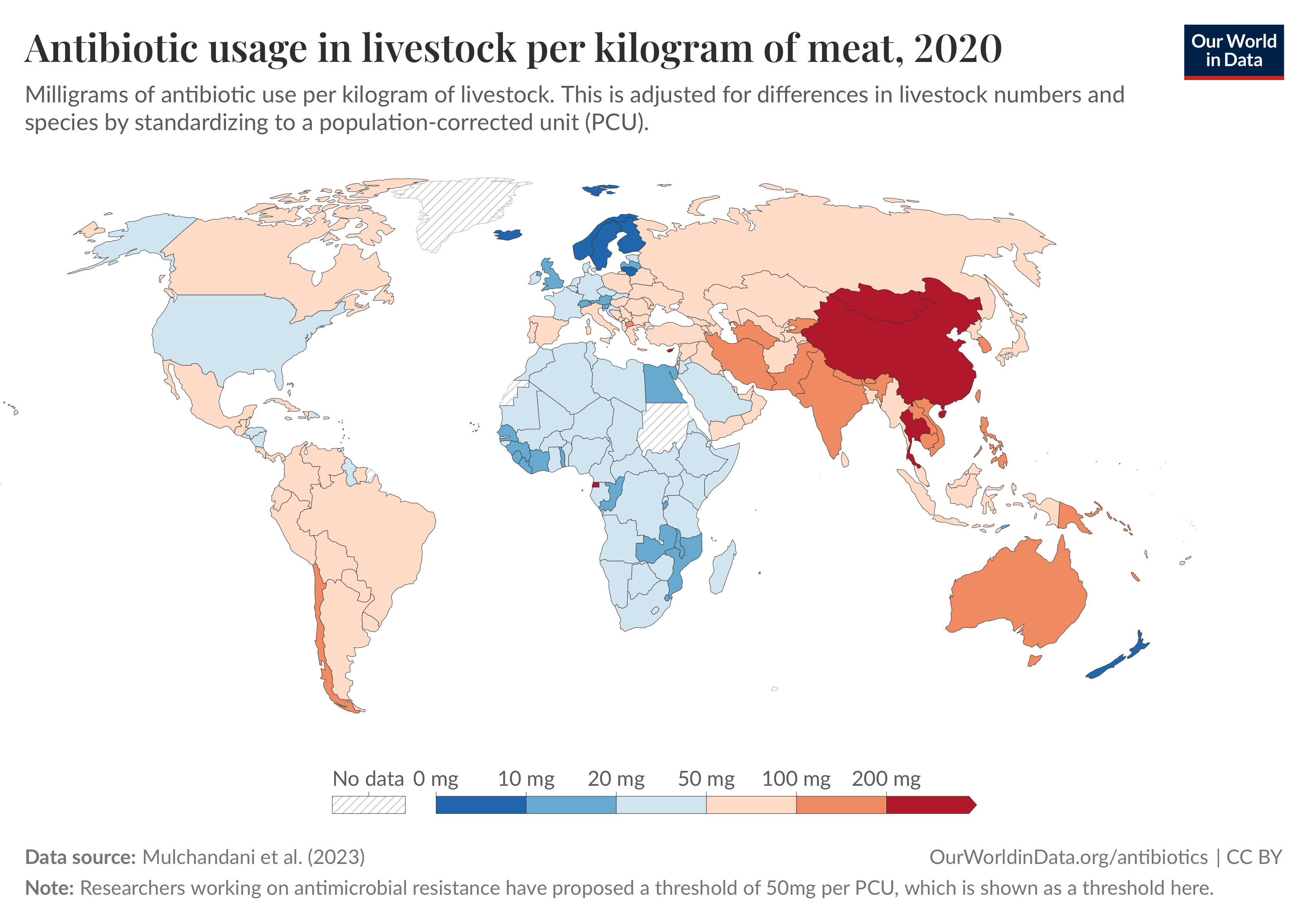
A second procedural practice that contributes to resistance is that, in many countries, the ill can purchase antibiotics without a doctor’s prescription. This is because in many developing countries there aren’t enough primary care doctors to write them; patients go to pharmacies and ask pharmacists to recommend what they think is apt.
When my brother, a doctor of emergency medicine, contracted a parasitic infection in India, he went to get tinidazole or metronidazole from a pharmacy. In the U.K., such targeted anti-parasitic drugs would require a prescription. But to my brother’s shock, along with the drugs he requested, the pharmacists offered him a number of other antibiotics, many of which must be administered intravenously. Not only would these antibiotics have been useless in treating his parasitic infection, one of them — gentamicin — risked causing deafness without prior blood tests and body measurements to determine an accurate dosage. But worse than this is that such broad availability of antibiotics heightens the risk of resistance.
Selection for resistance to antibiotics was understood as far back as Fleming’s Nobel Lecture in 1945, where he stated “I would like to sound one note of warning. Penicillin is to all intents and purposes non-poisonous so there is no need to worry about giving an overdose and poisoning the patient. There may be a danger, though, in underdosage. It is not difficult to make microbes resistant to penicillin in the laboratory by exposing them to concentrations not sufficient to kill them, and the same thing has occasionally happened in the body.” Unfortunately, such knowledge hasn’t proven equal to the task of combating the second cause of resistance: capitalism.
Of the 38 major “groups” of antibiotics known today, 28 were discovered between the 1940s and 1970s. Modern pharmaceutical companies have mostly abandoned antibiotic development because of poor profit margins. It costs an estimated $2.6 billion to develop a new class of antibiotic, according to Wellcome Trust estimates, but most drugs still fail to make it to the end of this development cycle due to unforeseen side effects or poor efficacy. When a new medicine is successfully developed and brought to market, market pressures make it vital that the company recoup a significant return to cover not just the development costs of that drug but also to cover the costs of failed attempts at other drugs.
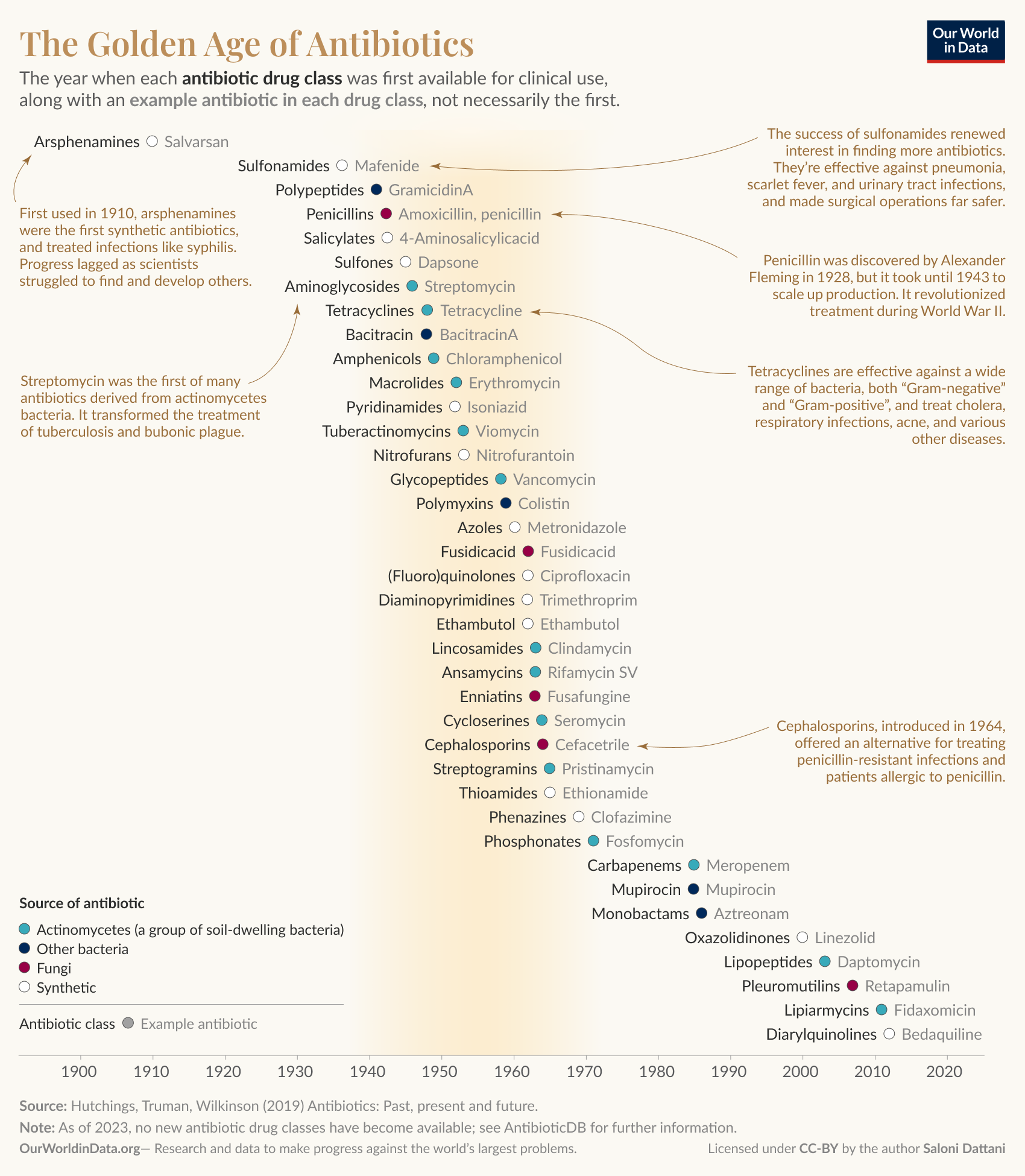
In almost all cases, the mechanism for drug companies to make money from the drugs they develop is through a temporary, patent-protected monopoly. Patents typically last 20 years, although companies often patent drugs before they are even ready for market to prevent getting scooped by other companies. This reduces the profitability window to less than 20 years once the drug is actually commercialized and sold. Chemically synthesized drugs, such as ibuprofen, are cheap to manufacture, as are simple molecules cultured biologically, such as human insulin.2 This allows companies to mark up such drugs significantly during the patent protection window. But as soon as these patents expire, competitors can make these same drugs and sell them for a much lower price, since they don’t need to recoup drug development costs.
If a new antibiotic entered the market tomorrow, one of two scenarios would likely play out.
Either the drug would be used as a last-line-of-defense antibiotic, with doctors keeping it in reserve to treat only the most resistant bacterial infections. Relatively few doses of the antibiotic would be sold during the patent protection when the parent company most needed to recoup its R&D investment costs. After a few decades, the drug might be used more frequently in the clinic; but by then the patent would have expired, and the drug would be sold at a much lower price by generic manufacturers, forcing the parent company to bring prices down in order to compete.
Or, alternatively, the drug would be widely prescribed from the start. But the more frequently it was used, the more widespread resistance would develop, and the less effective the drug would become. Even if initial sales were high, they would begin to taper off as resistance spread. The parent company would again struggle to make back its investment.
Antibiotics are also less remunerative because they are only taken for the brief period of active infection — usually a few days. In contrast, drugs for chronic diseases like diabetes, heart disease, or Alzheimer’s are used regularly for years. Thus, developing a new antibiotic doesn’t provide the same return as developing a drug for a chronic disease.
Efforts to fix antibiotic development generally come as either “push” or “pull” incentives. Push incentives tend to come from governments and non-profits, which provide funding for the development of new antibiotics. Multiple, large-scale initiatives, such as CARB-X, GARDP and JPIAMR,3 have supported the development of new antibiotics. Investments into antibiotic R&D, from both public and philanthropic sources, is estimated to equate to between $1.5-2 billion per year, matched by a similar amount from the private sector. Yet, it’s not clear how much these efforts have driven new antibiotic development, with the number of new drugs in the pipeline stuck in the low 40s as long as Pew Charitable Trusts has been monitoring it (from 2014 to 2021).
The collapse of the antibiotic startup Achaogen in 2019 was a wake-up call that push funding was not going to solve the problem on its own. Achaogen had developed a new antibiotic, plazomicin (branded as Zemdri), after receiving about $500 million of public and private funding. The company developed the new drug, ran clinical trials, and secured FDA approval; only to later fail.
The reason is that drug companies face steep costs even after drugs are approved, including infrastructure to support commercialization, access to international markets, and further trials to fulfill pediatric commitments.4 These costs are usually financed by the early sales of the drug, but many antibiotics sell poorly for the reasons mentioned earlier. In the first six months after plazomicin went to market, sales totaled just $800,000, and Achaogen filed for bankruptcy less than a year after its release. Jeremy Farrar, former Director of the Wellcome Trust, which invested in Achaogen, said the tragedy wasn’t that investors lost their money, but that it sent the message that “there is no viable route to commercial success for new antibiotics, however valuable they may be to society.”
Pull incentives, in contrast, try to guarantee some financial return for a new antibiotic entering the market, in the form of extended patents or up-front payments. These incentives are not as field tested, although there are recent examples that show promise.
In 2022, for example, the U.K. National Health Service (NHS) announced a new purchasing model for antibiotics. Rather than paying per dose, the NHS agreed to a subscription model, paying two pharmaceutical companies £10 million a year for 10 years for access to their new antibiotics. Such a cash guarantee fixes the perverse incentive for the companies to encourage overuse of the drugs while compensating for the fact that the new antibiotics will ideally be held in reserve for years before being prescribed. It uncouples actual patient use numbers from the developers’ initial remuneration.
The U.S. is hoping to implement similar incentives with The Pioneering Antimicrobial Subscriptions to End Upsurging Resistance (PASTEUR) Act. This act was first introduced to the U.S. Congress in 2020 — and reintroduced in 2021, 2023, and 2026 (still live in congress as this article goes to press) — but has so far failed to pass. If it ever does so, however, it would allow the federal government to sign subscription-style agreements with pharmaceutical companies that develop new antibiotics and antifungals, paying between $75-300 million per year. Sweden and Japan are implementing similar revenue guarantees.
In late 2025, the EU agreed on a patent extension policy where companies that register a new “priority antimicrobial” would be eligible for a 12-month extension for market exclusivity within the EU. This extension is transferable, so the company could employ it to increase the duration of their exclusive rights on another, more profitable drug. The policy also mandates compulsory medical prescriptions for all antimicrobials in the EU.
Other pull incentives are also under consideration. Market entry awards — lump sums awarded to drug companies when a drug reaches the market — could help companies avoid Achaogen’s fate and reassure investors that antibiotic discovery is financially viable. These are essentially prizes for getting a new antibiotic to market. Advanced market commitments are a promise to buy a batch of the product at a set price once it has been developed, and such commitments have successfully supported vaccine development. For example, in 2009 GAVI and the Gates Foundation pledged $1.5 billion to guarantee a price for companies that would produce a pneumococcal vaccine for low-income countries. By 2011, Pfizer and GSK had met those specifications. The advanced market commitment advanced development by around five years, saving an estimated 700,000 lives.
Pooling demand and agreeing a price in advance incentivizes companies to develop a product in a way that individual, smaller customers can’t manage, often because they cannot commit to a large enough volume to make development worthwhile. While market entry awards and advanced market commitments will exert a pull on antibiotic development, they do not have the added benefit of uncoupling profit from sales volume in the way that subscriptions do.
Importantly, all of these pull mechanisms still require drug developers to take on all R&D risks when developing a new drug, as the payments only kick in after the drug proves successful. The best solution to the drug development market failure, therefore, is likely a combination of push and pull incentives.
There is a recent counterexample worth studying, though. In December 2025, a new first-in-class antibiotic, gepotidacin, was approved by the FDA for the treatment of gonorrhoea and urinary tract infections. The last new antibiotic to treat gonorrhea was approved in 1987, so its approval bears notice. What made it successful when so many other antibiotics failed?
First, its mechanism is inherently averse to resistance. Gepotidacin inhibits DNA replication by targeting two topoisomerase enzymes, topoisomerase IV and the B subunit of DNA gyrase. Resistance is only conferred by concurrent mutations in both of those enzymes, which is much less likely than a single mutation.
Second, there is a clear market pull. There were over 300,000 cases of gonorrhoea in the U.S. in 2023, making it the second most prevalent sexually transmitted infection in the country, and up to 60 percent of women suffer from a UTI in their lifetime. Both of these infections are prone to resistance to the standard antibiotic treatments. More than 55 percent of U.S. outpatients’ UTIs proved resistant to common antibiotics, such as beta-lactams, and EU and U.K. guidelines raised concerns about adverse side effects from the other commonly used antibiotics.
Third, GSK retained its in-house antibiotic research expertise while other pharmaceutical companies sloughed theirs to prioritize development of more profitable drugs. Gepotidacin was discovered in-house in 2007. After promising early results in 2013, funding from multiple U.S. government agencies — including $200m from Biomedical Advanced Research and Development Authority (BARDA) and an undisclosed amount from the Defense Threat Reduction Agency (DTRA) — reduced both the expense and business risk of early antibiotic development. This funding functioned as a push incentive.
These three unique factors allowed GSK to justify their development of gepotidacin, which took 18 years to progress from discovery to market. It remains to be seen whether this drug will prove remunerative, though. And even if this model cannot solve antibiotic resistance across all diseases, it will hopefully signal a renaissance of new antibiotic development.
As we wait for the adoption of more push and pull incentives, the best way to slow rising antibiotic resistance is to steward existing antibiotics better — reducing their use in agriculture, improving healthcare capacity in low-income countries, and ensuring that existing antibiotics are more carefully administered.
Matt Burnett is a Frontier Specialist at ARIA. He holds a BSc in Microbiology and MSc in Biological and Bioprocess Engineering from the University of Sheffield and a MA in Global Affairs from Yale University. He coordinated the global communications network of the FAO Antimicrobial Resistance Working Group while working for the United Nations. This article was written in a personal capacity.
- Unpublished interview with Niko McCarty, Asimov Press. ↩
- Antibody drugs are very costly to manufacture but these aren’t relevant for this discussion of antibiotics. ↩
- Many of these groups are supported by national research agencies and large philanthropic funders, including the Wellcome Trust and Gates Foundation. ↩
- As trials in children are costly and provide access to a limited market, drug companies are not incentivized to do the necessary work to ensure safe use of new drugs in children. In order to overcome this lack of safety data, regulators will grant approval in adults with the agreement that the company will undertake the necessary trials in children in due course. ↩