%20!important%3B%22%2F%3E%0A%3Cpath%20d%3D%22M58.9724%2026.1292C57.6595%2026.1292%2055.9552%2025.7092%2054.1179%2024.896L54.1958%2021.3279H54.591C55.6132%2024.423%2057.4239%2025.3179%2058.9971%2025.3179C60.4411%2025.3179%2061.412%2024.5579%2061.412%2023.2184C61.412%2021.6186%2059.8369%2021.1455%2057.8172%2020.3323C55.4555%2019.3614%2054.04%2018.4437%2054.04%2016.5323C54.04%2014.1972%2055.902%2012.6753%2058.79%2012.6753C60.2717%2012.7131%2061.7288%2013.062%2063.0669%2013.6994L62.9871%2017.0567H62.5672C61.754%2014.1972%2060.1808%2013.4885%2058.7672%2013.4885C57.2187%2013.4885%2056.2231%2014.3017%2056.2231%2015.4569C56.2231%2016.899%2057.8761%2017.2657%2060.2131%2018.2366C62.0238%2018.9453%2063.5989%2019.8116%2063.5989%2022.0935C63.5913%2024.6547%2061.6324%2026.1292%2058.9724%2026.1292Z%22%20fill%3D%22%23123236%22%20style%3D%22fill%3A%20rgb(18%2C%2050%2C%2054)%20!important%3B%22%2F%3E%0A%3Cpath%20d%3D%22M63.8701%2025.5209C65.0234%2025.4164%2065.9601%2025.0744%2065.9601%2023.2637V15.4471C65.9601%2013.6364%2065.0101%2013.2944%2063.8891%2013.1899V12.8289H68.6106V23.2695C68.6106%2025.0801%2069.5606%2025.4221%2070.7101%2025.5266V25.8933H63.8701V25.5209ZM65.1298%209.1809C65.1368%208.71493%2065.3284%208.27077%2065.6625%207.9459C65.9967%207.62104%2066.446%207.44208%2066.912%207.44817C67.3783%207.44157%2067.8282%207.62033%2068.1627%207.94525C68.4973%208.27017%2068.6891%208.7146%2068.6961%209.1809C68.6954%209.41374%2068.6485%209.64416%2068.5583%209.8588C68.468%2010.0734%2068.3362%2010.2681%2068.1703%2010.4315C68.0044%2010.5949%2067.8078%2010.7238%2067.5919%2010.8108C67.3759%2010.8979%2067.1448%2010.9412%2066.912%2010.9384C66.4428%2010.9389%2065.9923%2010.7543%2065.6586%2010.4244C65.3248%2010.0946%2065.1348%209.64629%2065.1298%209.1771V9.1809Z%22%20fill%3D%22%23123236%22%20style%3D%22fill%3A%20rgb(18%2C%2050%2C%2054)%20!important%3B%22%2F%3E%0A%3Cpath%20d%3D%22M85.9783%2025.521C86.9492%2025.4165%2087.7358%2025.0746%2087.7358%2023.2639V17.1516C87.7358%2015.3162%2086.6604%2014.503%2085.3741%2014.503C84.4241%2014.503%2083.5387%2014.9476%2082.6989%2015.8919C82.7255%2016.1807%2082.7521%2016.4961%2082.7521%2016.8115V23.2715C82.7521%2025.0822%2083.5387%2025.4241%2084.5096%2025.5286V25.8954H78.3707V25.5286C79.3416%2025.4241%2080.1282%2025.0822%2080.1282%2023.2715V17.1592C80.1282%2015.3238%2079.0775%2014.5106%2077.7665%2014.5106C76.8165%2014.5106%2075.9824%2014.9552%2075.1426%2015.8995V23.2715C75.1426%2025.0822%2075.9311%2025.4241%2076.9799%2025.5286V25.8954H70.499V25.5286C71.601%2025.4241%2072.494%2025.0822%2072.494%2023.2715V15.4549C72.494%2013.6442%2071.601%2013.3022%2070.499%2013.1977V12.8291H75.1426V15.1908C76.1933%2013.5378%2077.5043%2012.6714%2079.1041%2012.6714C80.7039%2012.6714%2082.0947%2013.5112%2082.5678%2015.3219C83.6698%2013.5891%2085.0378%2012.6714%2086.687%2012.6714C88.6535%2012.6714%2090.3863%2014.0014%2090.3863%2016.8172V23.2772C90.3863%2025.0879%2091.2508%2025.4299%2092.3015%2025.5344V25.901H85.9783V25.521Z%22%20fill%3D%22%23123236%22%20style%3D%22fill%3A%20rgb(18%2C%2050%2C%2054)%20!important%3B%22%2F%3E%0A%3Cpath%20d%3D%22M98.5056%2026.0987C95.1217%2026.0987%2092.209%2023.5014%2092.209%2019.329C92.209%2015.1566%2095.1217%2012.6658%2098.5056%2012.6658C101.889%2012.6658%20104.829%2015.1851%20104.829%2019.329C104.829%2023.4729%20101.889%2026.0987%2098.5056%2026.0987ZM95.1996%2019.329C95.1996%2022.2949%2096.1705%2025.3368%2098.5056%2025.3368C100.841%2025.3368%20101.838%2022.3196%20101.838%2019.329C101.838%2016.3384%20100.814%2013.4276%2098.5056%2013.4276C96.1971%2013.4276%2095.1996%2016.365%2095.1996%2019.329Z%22%20fill%3D%22%23123236%22%20style%3D%22fill%3A%20rgb(18%2C%2050%2C%2054)%20!important%3B%22%2F%3E%0A%3Cpath%20d%3D%22M106.111%2015.2991C105.402%2013.6195%20104.669%2013.3041%20103.855%2013.1996V12.8291H110.315V13.1958C109.162%2013.3269%20108.453%2013.6955%20109.109%2015.2953L112.073%2022.483L114.959%2015.2953C115.616%2013.6423%20114.723%2013.3003%20113.648%2013.1958V12.8291H118.187V13.1958C117.321%2013.3003%20116.508%2013.6423%20115.825%2015.3219L111.602%2025.8878H110.578L106.111%2015.2991Z%22%20fill%3D%22%23123236%22%20style%3D%22fill%3A%20rgb(18%2C%2050%2C%2054)%20!important%3B%22%2F%3E%0A%3Cpath%20d%3D%22M122.474%2025.4944C123.68%2025.3899%20124.678%2025.0232%20124.678%2023.1327V9.7529C124.678%207.8643%20123.68%207.49761%20122.474%207.39311V6.99976H131.261C134.936%206.99976%20137.506%209.49065%20137.506%2012.7434C137.506%2016.3914%20134.466%2018.5689%20130.737%2018.5689H127.588V23.1289C127.588%2025.0289%20128.613%2025.3861%20129.792%2025.4906V25.8839H122.474V25.4944ZM127.588%2017.7291H130.248C132.846%2017.7291%20134.446%2015.4737%20134.446%2012.7434C134.446%2010.0948%20132.977%207.83768%20130.406%207.83768H127.598L127.588%2017.7291Z%22%20fill%3D%22%23123236%22%20style%3D%22fill%3A%20rgb(18%2C%2050%2C%2054)%20!important%3B%22%2F%3E%0A%3Cpath%20d%3D%22M137.533%2025.5207C138.635%2025.4162%20139.553%2025.0743%20139.553%2023.2636V15.4469C139.553%2013.6362%20138.635%2013.2943%20137.533%2013.1898V12.8288H142.23V17.0258C142.832%2014.5084%20144.852%2012.2512%20147.449%2012.7756L147.056%2015.4793H146.866C144.713%2014.5863%20142.589%2016.1613%20142.222%2019.2032V23.2693C142.222%2025.08%20143.14%2025.422%20144.242%2025.5265V25.8931H137.525L137.533%2025.5207Z%22%20fill%3D%22%23123236%22%20style%3D%22fill%3A%20rgb(18%2C%2050%2C%2054)%20!important%3B%22%2F%3E%0A%3Cpath%20d%3D%22M153.488%2026.0987C150.366%2026.0987%20147.533%2023.6591%20147.533%2019.3557C147.533%2015.2631%20149.946%2012.6658%20153.332%2012.6658C156.794%2012.6658%20158.709%2015.3941%20158.682%2018.9623H150.322C150.4%2022.5571%20152.184%2024.4458%20154.493%2024.4458C155.937%2024.4458%20157.326%2023.7636%20158.403%2022.3728L158.717%2022.4508C158.326%2023.5228%20157.614%2024.4484%20156.679%2025.1012C155.743%2025.754%20154.629%2026.1023%20153.488%2026.0987ZM150.34%2018.2023H155.954C155.876%2015.7608%20154.958%2013.4523%20153.252%2013.4523C151.417%2013.4523%20150.473%2015.9451%20150.34%2018.2023Z%22%20fill%3D%22%23123236%22%20style%3D%22fill%3A%20rgb(18%2C%2050%2C%2054)%20!important%3B%22%2F%3E%0A%3Cpath%20d%3D%22M164.817%2026.1292C163.506%2026.1292%20161.8%2025.7092%20159.964%2024.896L160.042%2021.3279H160.432C161.456%2024.423%20163.265%2025.3179%20164.84%2025.3179C166.282%2025.3179%20167.253%2024.5579%20167.253%2023.2184C167.253%2021.6186%20165.68%2021.1455%20163.658%2020.3323C161.298%2019.3614%20159.881%2018.4437%20159.881%2016.5323C159.881%2014.1972%20161.743%2012.6753%20164.631%2012.6753C166.113%2012.7128%20167.57%2013.0618%20168.908%2013.6994L168.83%2017.0567H168.412C167.599%2014.1972%20166.024%2013.4885%20164.612%2013.4885C163.063%2013.4885%20162.066%2014.3017%20162.066%2015.4569C162.066%2016.899%20163.719%2017.2657%20166.056%2018.2366C167.867%2018.9453%20169.44%2019.8116%20169.44%2022.0935C169.434%2024.6547%20167.462%2026.1292%20164.817%2026.1292Z%22%20fill%3D%22%23123236%22%20style%3D%22fill%3A%20rgb(18%2C%2050%2C%2054)%20!important%3B%22%2F%3E%0A%3Cpath%20d%3D%22M175.374%2026.1292C174.061%2026.1292%20172.357%2025.7092%20170.519%2024.896L170.597%2021.3279H170.992C172.015%2024.423%20173.825%2025.3179%20175.398%2025.3179C176.842%2025.3179%20177.813%2024.5579%20177.813%2023.2184C177.813%2021.6186%20176.238%2021.1455%20174.219%2020.3323C171.857%2019.3614%20170.441%2018.4437%20170.441%2016.5323C170.441%2014.1972%20172.303%2012.6753%20175.191%2012.6753C176.673%2012.7131%20178.13%2013.062%20179.468%2013.6994L179.388%2017.0567H178.969C178.155%2014.1972%20176.582%2013.4885%20175.169%2013.4885C173.62%2013.4885%20172.625%2014.3017%20172.625%2015.4569C172.625%2016.899%20174.278%2017.2657%20176.615%2018.2366C178.425%2018.9453%20180%2019.8116%20180%2022.0935C179.991%2024.6547%20178.022%2026.1292%20175.374%2026.1292Z%22%20fill%3D%22%23123236%22%20style%3D%22fill%3A%20rgb(18%2C%2050%2C%2054)%20!important%3B%22%2F%3E%0A%3Cpath%20d%3D%22M22.4922%2011.2518C22.4892%208.37895%2021.3888%205.61569%2019.4159%203.52733C17.4431%201.43898%2014.7468%200.183268%2011.8788%200.0170703V0H10.6134V0.0170703C7.74531%200.183268%205.04911%201.43898%203.07625%203.52733C1.10338%205.61569%200.00294138%208.37895%200%2011.2518V33.1189H0.632691C2.96479%2033.1153%205.2383%2032.388%207.13939%2031.0372C9.04048%2029.6864%2010.4754%2027.7789%2011.2461%2025.5778C12.018%2027.7776%2013.4533%2029.6838%2015.3543%2031.0335C17.2553%2032.3832%2019.5281%2033.1097%2021.8595%2033.1131H22.4922V11.2518ZM21.2268%2011.2518C21.2224%2013.7878%2020.2544%2016.2273%2018.5187%2018.0762C16.783%2019.9252%2014.4094%2021.0453%2011.8788%2021.2096V1.27869C14.4122%201.44322%2016.7882%202.56537%2018.5246%204.41749C20.261%206.26962%2021.2277%208.71304%2021.2287%2011.2518H21.2268ZM1.26731%2031.8287V11.2518C1.26878%208.71426%202.23567%206.27223%203.97174%204.42148C5.70781%202.57073%208.083%201.44987%2010.6153%201.2863V21.8746C10.6096%2024.4098%209.64093%2026.8482%207.90542%2028.6963C6.16991%2030.5443%203.79715%2031.664%201.26731%2031.8287ZM21.2287%2031.8287C18.8025%2031.6704%2016.5171%2030.6333%2014.8004%2028.9116C13.0836%2027.1899%2012.0531%2024.9017%2011.9016%2022.4751C13.8477%2022.3595%2015.7303%2021.7405%2017.3653%2020.6787C19.0003%2019.6169%2020.3315%2018.1487%2021.2287%2016.4179V31.8287Z%22%20fill%3D%22%23123236%22%20style%3D%22fill%3A%20rgb(18%2C%2050%2C%2054)%20!important%3B%22%2F%3E%0A%3C%2Fsvg%3E)
Theories are feats of scientific imagination that illuminate and unify our understanding of reality. Far from being mere generalizations of empirical data done after the fact, theories orient us toward the unseen, toward what lies “beyond our grasp.” As systems biologist Jeremy Gunawardena puts it,
If scientific research is stumbling around in a dark cellar looking for a black cat, then biology is doing so without knowing there is a cat there until one accidentally falls over it. Theory can sometimes conjure up the cat before the accident.
In biology, the cats in question are particularly elusive. Sometimes you don’t even get to fall over them, because all you can see is a smile lingering after the rest of the cat melted into the air. You may hypothesize the existence of ion channels or cell receptors but it might take years or decades before someone else identifies them experimentally. In the meantime, you have to hold on to the cat’s smile because it is so suggestive of the whole cat and explains so much.
But imagining that an unseen entity exists is only one kind of theoretical leap in biology. Some cats instead belong to a whole clowder, and you must figure out not only the cats themselves but also how they interact with one another. In other words, you must imagine how an entire biological process works: which components are involved, how they interact, and what those interactions are used for. In some cases, theoretical biologists have made such leaps in the absence of any direct experimental evidence. These are amongst the most imaginative achievements of the scientific mind.
Two of them, the chemiosmotic theory and the clonal selection theory of adaptive immunity, are particularly noteworthy. They proposed mechanisms for two fundamental processes of life — how cells generate energy to power themselves and how the body mounts a defense against pathogens — before any pre-existing analogs were known.
What were the reasoning paths that led to these theories? Can they be traced at all?
It is rarely acknowledged to what extent biologists’ broader philosophical commitments guide their theoretical thinking. This is especially evident in the two theories above. In both, the scientists’ philosophical background allowed them to break away from existing theoretical frameworks and offer their own, at first seemingly outlandish and bizarre, but later ultimately experimentally validated, theories. By examining the ideas they borrowed and assumptions they questioned, we can begin to understand how such feats of imagination become feasible and learn to make others.
Chemiosmotic Theory
The British biochemist Peter Mitchell formulated his chemiosmotic theory of oxidative phosphorylation in 1961 without “a shred of experimental evidence.” But the theory didn’t come out of nowhere either. It was ultimately a result of a lifelong development of Mitchell’s idiosyncratic philosophical framework related to general foundations of life.
When he was a graduate student at Cambridge in the 1940s, Mitchell proposed a system of entities called statids, fluctids and fluctoids, echoing the ideas of the pre-Socratic philosopher Heraclitus of Ephesus. As their names suggest, statids are stable structural elements while fluctids are constantly in flux, exchanging matter with the environment, like a flame. Fluctoids are a combination of a flowing element with a static element, like a Bunsen burner.1 Though this framework may seem too abstract and far-fetched to be useful in biology, Mitchell integrated it productively into his life’s work in various biological contexts, culminating in the formulation of chemiosmotic theory.
The central problem that chemiosmotic theory addresses is the source of the energy that fuels ATP synthesis in mitochondria during cellular respiration — a process known as oxidative phosphorylation (so named as it requires oxygen to proceed and results in the phosphorylation of ADP into ATP).
The prevailing chemical theory of oxidative phosphorylation at the time postulated the existence of a “high-energy” chemical intermediate, similar to what happens in glycolysis.2 But no such intermediate was ever isolated, despite persistent attempts. On the other hand, it wasn’t possible to reproduce oxidative phosphorylation in a membrane-free in vitro system, even though the chemical theory didn’t require membranes.
The leap of imagination that Mitchell made in 1961 was to connect the metabolic reaction of ATP synthesis with the active transport of ions across membranes. In an earlier paper from 1959,3 Mitchell presciently wrote:
In view of certain similarities between mitochondrial membranes and the plasma- membranes of bacteria, I would venture to suggest that the function of the membranes of mitochondria and of the endoplasmic reticulum may be, like that of the plasma membrane, to act as chemi-osmotic links between the media that they separate.
This connection was in line with the innovative concept of “vectorial metabolism” that Mitchell developed — metabolic processes that have a direction in space, as opposed to “scalar metabolism” where the direction doesn’t matter, as was generally assumed to be the case in biochemistry at the time. A scalar enzymatic reaction could become vectorial if the reacting substances arrived on one side of the membrane and the products left on the other.
Because he wasn’t constrained by the then prevailing chemical theory, Mitchell was able to resolve the two major issues that the chemical theory was unfit to explain — the lack of a chemical intermediate in the process in question and its dependence on membranes. In Mitchell’s terms, the chemiosmotic theory of oxidative phosphorylation describes a fluctoid system with a structural statid element, the semipermeable membrane, and a flowing fluctid element, the protons and electrons moving across the membrane, thus providing energy for ATP synthesis.
Mitchell’s conception of vectorial metabolism was also influenced by his readings of early 20th century biologists and philosophers of science, including D’Arcy Thompson, Joseph Needham and Joseph Woodger. Woodger’s ideas were especially crucial: first, the notion of life as persisting through change in response to the environment, and second, the conception of the cell as a “spatio-temporal structure in which the various kinetic processes are an integral part of that structure.” From this Mitchell inferred that the interaction with the environment (through the transport across cellular membranes) and the processes happening inside the cell (such as metabolism) had to be inextricably linked.4
Mitchell was also aware of earlier studies that showed dependence on respiration of the mineral ion uptake from the soil by plant roots, and the same dependence was demonstrated for acid secretion in the stomach. These studies hinted at a tantalizing connection between the process that feeds into oxidative phosphorylation (respiration) and the ion transport across membranes. Taken together, Woodger’s theoretical considerations (which in essence aligned with Mitchell’s original fluctoid system) and the indirect experimental evidence from plant roots and animal stomachs provided the basis for Mitchell’s leap into formulating chemiosmotic theory.
But the theory wasn’t met with enthusiasm among his contemporaries, and Mitchell, who also suffered from gastric ulcers, left academia in 1963 to set up his own organization, the Glynn Research Institute, with his family’s financial support.5 There he continued to revise his theory, working on its experimental verification for the next few decades. As experimental support for the chemiosmotic theory accumulated over time, the resistance against it in academic circles subsided, and Mitchell was awarded the Nobel Prize in Chemistry in 1978.
Clonal selection theory of immunity
The self vs. non-self recognition that is at the heart of the immune response represents a unique philosophical problem in biology, and understanding it has required theoretical ingenuity far ahead of what was known from contemporaneous experimental work. The clonal selection theory of immunity describes a fundamental process by which an organism develops its ability to recognize and mount an adaptive immune response against any foreign agents it may come in contact with.6 This process was deciphered over decades, spread out among several scientists — the German Paul Ehrlich, the Dane Niels Kaj Jerne, the American David Talmage and the Australian Macfarlane Burnet. All except Talmage were awarded, in different years, the Nobel Prize in Physiology or Medicine for other discoveries, but none for the clonal selection theory itself.
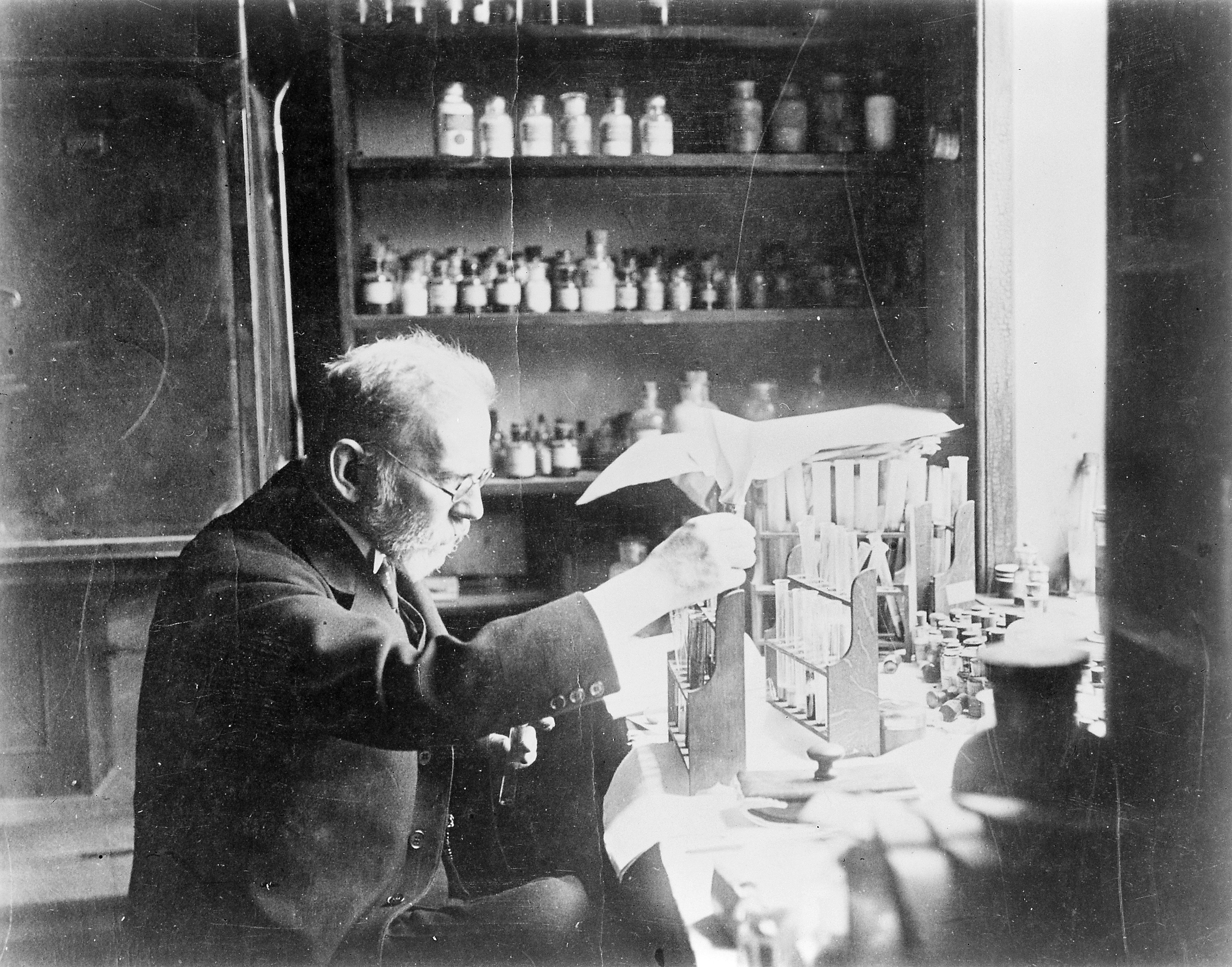
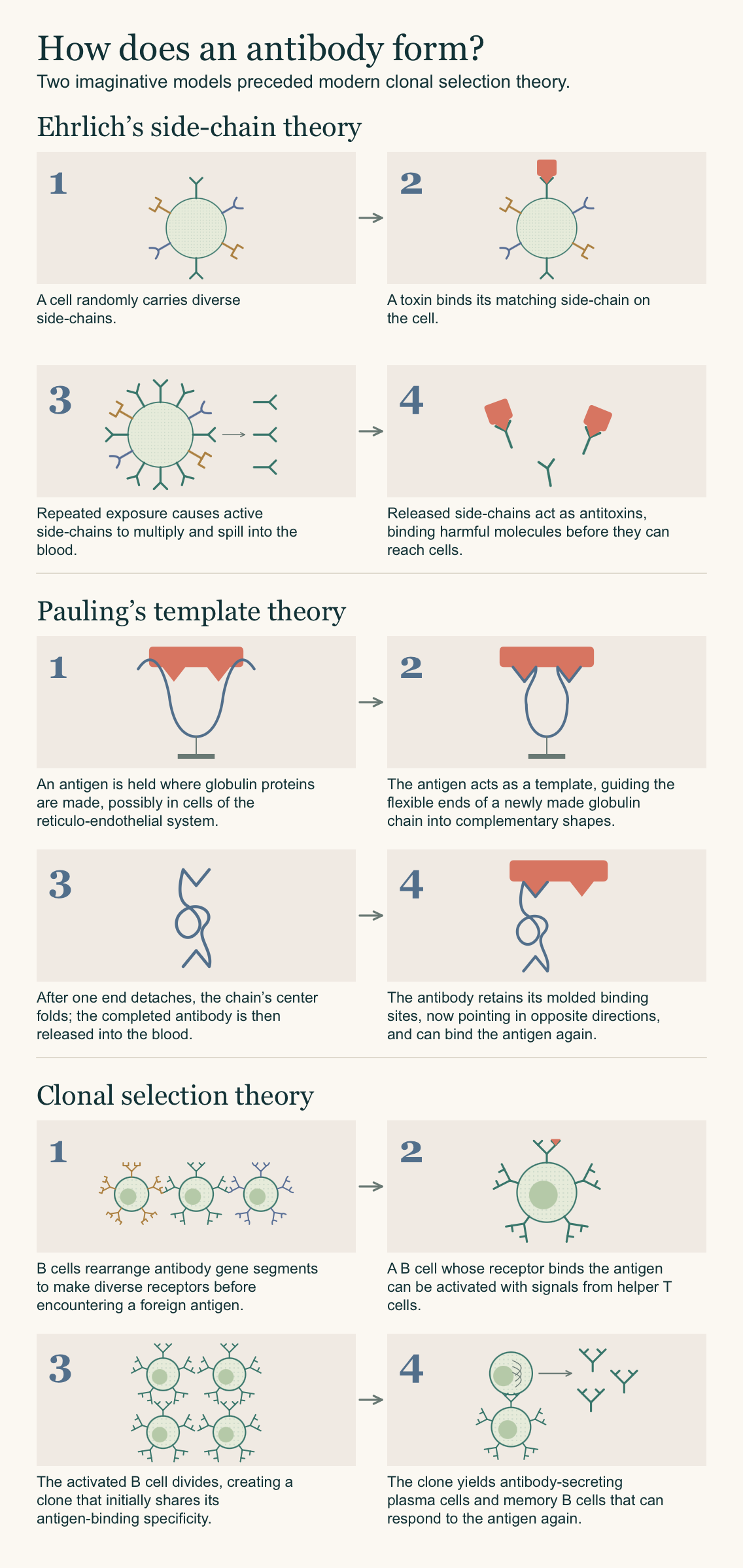
The origins of the theory date back to “the father of immunology”, Paul Ehrlich,7 who in the late 19th century anticipated many of the fundamental principles of adaptive immunity, some inaccuracies notwithstanding. Without any direct experimental evidence,8 he suggested that all cells in the body carry Seitenketten (“side-chains” in German) that normally bind nutrients, and that antigens from foreign substances like toxins can be recognized by some of those side-chains (receptors). As a result of this interaction, the cells are functionally activated and produce an excess of antigen-specific side-chains, which are then released into the bloodstream as antibodies that neutralize the toxin. He also considered that antibody formation could be a dedicated function of the cells of “haemopoietic tissue.” What he didn’t realize is that each antibody-producing cell bears receptors of a single-antigen specificity, rather than a variety of them at once.
Most presciently, Ehrlich proposed that there must be a preexisting repertoire of antibody specificities for a variety of antigens that an organism may encounter throughout its lifespan, and that the antigens act to select from among this pool of specific antibodies. This appears to be a major leap of imagination on the part of the German scientist. However, Ehrlich was himself somewhat conflicted about this point:
It would not be reasonable to suppose that there were present in the organism many hundreds of atomic groups destined to unite with toxins, when the latter appeared, but in function really playing no part in the processes of normal life, and only arbitrarily brought into relationship with them by the will of the investigator. It would indeed be highly superfluous, for example, for all our native animals to possess in their tissues atomic groups deliberately adapted to unite with abrin, ricin, and crotin, substances coming from the far distant tropics.
By this time it was already experimentally shown that antibodies against those substances can in fact be raised in animals. Combined with the evidence from the 1920s9 that specific antibodies can be induced even in response to synthetic chemicals, this led to the abandonment of Ehrlich’s preformation theory and an increasing adoption of alternative, template (also known as instructionist) theories. Such theories postulated that the antigens themselves act as a template, “instructing” the formation of a complementary antibody structure.10 Linus Pauling, for example, suggested that newly synthesized native globulin molecules can fold around antigen molecules, with antigens thus serving as templates that transform the otherwise neutral blood proteins into specific antibodies.
But in the 1950s, Niels Jerne dealt a decisive blow to the template theories. To be sure, these theories had multiple known problems, including their inability to explain the prolonged production of antigen-specific antibodies after the antigen had cleared from the organism (how could such antibodies persist in the absence of a template?). Neither could they account for the booster phenomenon — the dramatic increase in the concentration of antigen-specific antibodies after a repeated injection of an antigen.
Finally, the template theories were also incompatible with another empirical observation — that the avidity of antibodies (the “tightness” of their binding to the antigen, measured by how quickly they neutralize it) increases significantly in the course of immunization, with later antibodies becoming much more avid than the early titres. Jerne’s natural selection theory solved all of these incongruities by postulating a mechanism remarkably similar to Ehrlich’s preformation theory, and yet independent from it, and with a more developed philosophical grounding.
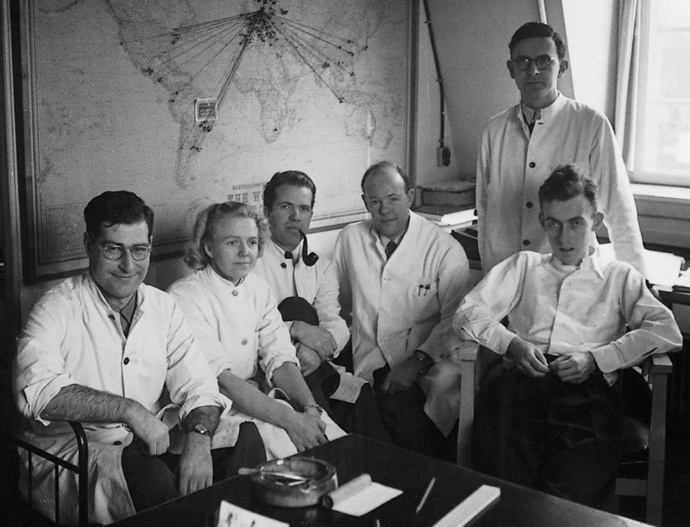
Before he formulated his theory in 1955, Jerne spent more than a decade researching the avidity of antibodies and developing new sensitive quantitative assays along the way. In particular, he used plaque formation by bacteriophages as an indirect readout of antibody binding. In a crucial series of experiments, he immunized a horse with high titres of bacteriophage T4 and took serum samples over a time series.
Jerne found T4-specific antibodies already in the early first samples, but more surprisingly, he was able to detect anti-T4 activity even in the controls — in the serum of non-immunized animals. This could either be because they had already been exposed to the T4 bacteriophage earlier in their lives (which would be in line with the template theories) or, thrillingly, because it was instead a “natural antibody” spontaneously produced by all healthy animals even if they had never encountered T4 before. Jerne went with the latter interpretation, even though, strictly speaking, his experiments did not demonstrate that.11 It was a theoretical supposition that relied more on Jerne’s philosophical considerations than on direct empirical evidence.
Why was the existence of natural antibodies so important? Scores of immunologists before Jerne had been aware of the phenomenon,12 yet none went in the theoretical direction he pursued. But Jerne had a rigorous background in biostatistics and a keen interest in Neo-Darwinism through the works of R. A. Fisher and Max Delbrück. This unique intellectual background prepared him to make the inference that the presence of natural antibodies was an indication that a selection process was at play. From a preexisting pool of continuously produced natural antibodies, antigens select ones that can inherently bind them (rather than “instruct” their formation de novo), which leads to the amplification of this specific fraction of antibodies.
In other words, “the function of the antigen is to exert a population pressure on the distribution of a heterogeneous globulin population,” as he wrote in a letter to a colleague.13 In a way, Jerne pioneered the use of Darwinian ideas to explain physiological phenomena:
Darwinian ‘selection of the fittest’ had hitherto been applied only with regard to the diversity of plant and animal species. I think I was the first to propose that the Darwinian selection principle was also possible and indeed applied, within the diversity of cells within a single polycellular organism, i.e. ‘physiologically.’14
In addition to Neo-Darwinism, there was another philosophical influence that Jerne highlighted in his famous retrospective essay, The Natural Selection Theory of Antibody Formation: Ten Years Later (1966). It seems that his idea of the preexisting antibody repertoire drew in part from the interpretation of the Socratic notion of “learning as recollection” by the Danish existentialist philosopher Søren Kierkegaard:
Can the truth (the capability to synthesize an antibody) be learned? If so, it must be assumed not to pre-exist; to be learned, it must be acquired. We are thus confronted with the difficulty to which Socrates calls attention in Meno (Socrates, 375 B.C.), namely that it makes as little sense to search for what one does not know as to search for what one knows; what one knows one cannot search for, since one knows it already, and what one does not know one cannot search for, since one does not even know what to search for. Socrates resolved this difficulty by postulating that learning is nothing but recollection. The truth (the capability to synthesize an antibody) cannot be brought in, but was already inherent. [parentheses added by Jerne]
Accordingly, Jerne’s theory predicted that there must be a “random mechanism” that generates the initial diversity of antibodies in the absence of foreign antigens. It additionally postulated a “purging mechanism” that ensures the elimination of antibodies which recognize the body’s own antigens. However, his “selective mechanism” for the propagation of the best-fitting antibodies wasn’t flawless: natural selection acted at the molecular level, on the antibodies themselves, but the theory couldn’t convincingly account for how the antibodies expanded and multiplied in numbers in the course of an immune response.
Jerne did suggest that the antibody-antigen complex is somehow engulfed by a phagocytic cell and transported to other cells that can produce more antibodies of the same kind. But this threatened to challenge the central dogma of molecular biology: How can proteins cause synthesis of more of their kind? That would require a reverse flow of information from proteins to DNA. Thus, several scientists, including Linus Pauling and James Watson, rejected Jerne’s theory outright, though his more Darwinian-minded colleagues, like Günther Stent and Joshua Lederberg, welcomed it more enthusiastically.
Jerne’s theory didn’t perish but was instead modified into a cellular selection theory. In a 1957 review David Talmage credited Jerne with originating the modern idea of selection in immunology and added a tentative but crucial detail (a rare case where the advancement of science happens in a review article):
… it is tempting to consider that one of the multiplying units in the antibody response is the cell itself. According to this hypothesis, only those cells are selected for multiplication whose synthesized product has affinity for the antigen injected. This would have the disadvantage of requiring a different species of cell for each species of protein produced, but would not increase the total amount of configurational information required on the hereditary process. (italics added)
This shift from the selection at the antibody level to the selection at the cell level proved decisive. The Australian immunologist Macfarlane Burnet was also among those who responded favorably to Jerne’s theory, especially given its Darwinian mechanism (in contrast to the Lamarckist implications of the template theories), and found it “attractive, though obviously wrong.” Burnet’s solution was to replace antibody molecules with cell clones and their membrane receptors, similar to what was proposed by Talmage earlier that year.15
In a paper published in 1957, which he judiciously titled A modification of Jerne’s theory of antibody production using the concept of clonal selection, Burnet proposed that large numbers of lymphoid cell clones were programmed to produce antibodies of a large variety of distinct specificities. When an antigen enters the body, the cell clones that happen to produce antibodies against that antigen are thus “selected” for and expand into much larger clones, which start releasing more antibodies against the invading antigen.
This is now known as Burnet’s clonal selection theory. To his credit, Burnet continued to acknowledge Jerne’s role in its origins: “As I hope I have always been careful to say, its ‘onlie begetter’ was Niels Jerne.”16 Interestingly, for Burnet the main virtue of the theory was in explaining the “self vs. non-self” distinction, which became a major focus of his later investigations.
Yet as Burnet initially had his doubts about the clonal selection theory, it is telling that he published it in the obscure Australian Journal of Science, explaining the choice in his autobiography: “If, perish the thought, there was something very wrong about the clonal selection concept, the publication in an out-of-the-way Australian journal would mean that very few people in America or England would see it.”
Happily, the first confirming experimental evidence for the clonal selection theory arrived in 1958 when Gustav Nossal and Joshua Lederberg showed that each lymphoid cell produces only one kind of antibody by binding specificity. In 1976 Susumu Tonegawa’s discovery of V(D)J recombination further clarified the molecular foundations of the generation of antibody diversity.
In his autobiography, Burnet ultimately stated, “I regard the development of the clonal selection theory of immunity as my most important scientific achievement.”
When a biologist considers a theory his main contribution to science, that says something! Indeed, the clonal selection theory of immunity laid the foundations for understanding immunological memory and immunological tolerance (it was for its discovery that Burnet shared a Nobel Prize in Physiology and Medicine with Peter Medawar in 1960), and eventually made the development of monoclonal antibodies possible. Its organizing force in immunology was akin to what Mendeleev’s periodic table did in chemistry or what, indeed, Darwinian evolution did in biology as a whole.
To discern order in a dizzying complexity of nature is theoretical thinking at its finest. Theories provide explanations for our observations and unify existing disjoint bodies of knowledge. But they also leap forward, ahead of what we can assert based solely on our observations.
The most overarching theories, like universal laws of physics, light up the whole dark cellar for us to see the various cats that might be hiding there, to come back to Gunawardena’s image. A more circumscribed mechanistic theory in biology helps us predict the location and shape of a particular cat (or a bundle thereof) so we can prepare for our encounter with it, by designing experiments to identify it (or realize that it is not there at all), rather than stumbling upon it serendipitously in the dark.
Ulkar Aghayeva is a science writer and columnist at Asimov Press. She also writes at the science history blog Measure for Measure and music blog The Bass Line.
Header image by Ella Watkins-Dulaney.
Cite: Aghayeva, U. “Great Leaps in Biological Theory.” Asimov Press (2026). DOI: 10.62211/56hq-78uy
- Mitchell’s biographers suggest that this system was initially developed as a part of his doctoral thesis which was rejected by the examiners as too speculative. He barely ever mentioned it in print after that, with the exception of a symposium paper on the origins of life in 1956. Yet the concepts seem to underlie much of his work. ↩
- Referred to as “substrate-level phosphorylation” – synthesis of ATP or GTP by transferring the phosphate group onto the corresponding nucleoside diphosphate (ADP or GDP) from a high-energy intermediate molecule. ↩
- “Structure and Function in Microorganisms,” published in Biochemical Society Symposium (No. 16, pages 73–93), not available online. ↩
- When Mitchell was at Cambridge, his PhD supervisor Jim Danielli’s lab focused on cell membranes, while another major research group led by Malcolm Dixon specialized in soluble enzymes, and the two labs rarely interacted. Mitchell’s work can be seen as a synthesis of the two research programs. ↩
- What might have become of Mitchell’s work had it remained dependent on the conventional research grant system? ↩
- In addition to the adaptive immune response, the innate pathway recognizes foreign antigens through a cellular mechanism, phagocytosis by macrophages, which was discovered by Ilya Metchnikoff. At the molecular level, this involves a repertoire of genetically encoded pattern-recognition receptors expressed by macrophages that detect conserved molecular features of microorganisms associated with tissue damage. ↩
- Not to be confused with Paul R. Ehrlich (1932–2026), the American environmentalist and the author of The Population Bomb (1968), known for his neo-Malthusian views. ↩
- Though he had extensive prior experience working on the diphtheria toxin / antitoxin system and immunization in animal models. ↩
- Austrian immunologist Karl Landsteiner’s experiments with synthetic haptens. Haptens are small molecules that are usually non-immunogenic by themselves but that can induce an immune response when attached to larger carriers like proteins. Landsteiner thought that the number of antigens is effectively “infinite” and that a limited repertoire of different preformed side-chain specificities that Ehrlich proposed would not be sufficient to respond to all antigens an organism may encounter in its life. ↩
- This is not a completely outlandish idea in itself, as we now know that intrinsically disordered proteins can in fact acquire specific structures upon binding with other molecules. However, this is certainly not the case in antibody-antigen interactions. ↩
- In the paper describing these experiments, Jerne argued that “since normal serum contains so many different antibodies against a variety of bacteria, it is difficult to imagine that they are all the result of infection, particularly since these bacteria did not occur in the animal’s natural environment.” ↩
- Natural antibodies echo Ehrlich’s idea of the preformed side-chains, and their presence in non-immunized animals was known in the serological literature for decades. But with the decline of Ehrlich’s theory in the 1920s, natural antibodies were widely “dismissed as theoretical impossibilities,” since according to the template theories, antibodies were thought to be formed de novo in response to the encounter with new antigens. ↩
- A letter to his former supervisor, Ole Maaløe, on October 16, 1954. ↩
- In a letter to Thomas Söderqvist, July 8, 1993. Interestingly, as Söderqvist also writes, “the three generations of theories of antibody formation are correlated in time with three generations of general evolutionary theories: Ehrlich’s side-chain theory from the turn of the century was proposed within the framework of nineteenth-century Darwinian selectionist ideas; the template theories of the 1930s coincided with the decline of Darwinism and the corresponding popularity of neo-Lamarckism; and finally, the revival of the selectionist idea in immunology in the 1950s followed in the wake of the neo-Darwinian synthesis.” ↩
- Whether Burnet came up with the idea of clonal selection completely independently from David Talmage’s 1957 review article (of which he had received an advance copy) is contested by historians of science but I won’t address that here. At any rate, Talmage himself was of the view that Burnet “truthfully had developed the idea before he received my paper.” Burnet’s 1957 paper does cite Talmage’s review. ↩
- The “onlie begetter” refers to the dedication in the original 1609 edition of William Shakespeare’s Sonnets: “To the onlie begetter of these insving sonnets Mr W. H.” Begetter here could mean “the muse who inspired the work” or “the person who the manuscript is dedicated to.” ↩